Free On-Site or Photo EstimateWritten Quote in 24 HoursPatch Repairs $300-$600
Parging Manotick
Foundation parging repair and recoating for Manotick’s heritage village core and surrounding estate homes.
Get my 24-hour quote
Tell us your Manotick address.
Service availability is confirmed for each request.
Local factors we plan around
Heritage village core
Manotick's historic core along the Rideau River, near Watson's Mill, includes some of the area's oldest foundations.
Estate-lot homes
Surrounding Manotick carries larger estate lots with newer custom-built homes.
Rideau River setting
Riverside properties get extra attention to grading and moisture exposure.
Recent project
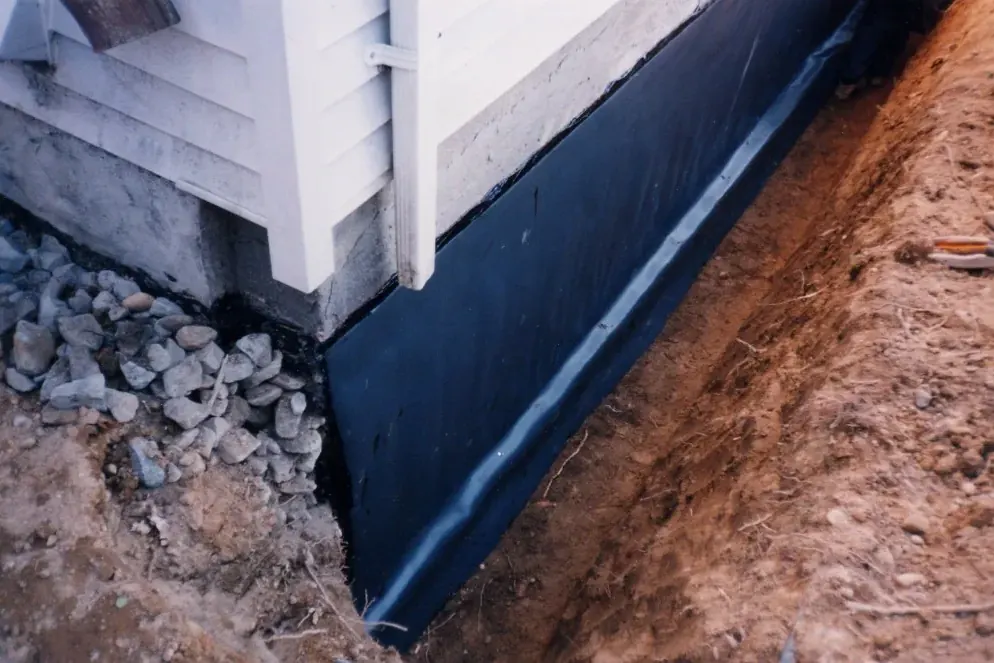
Waterproofing membrane on an excavated foundation
With the soil dug out along the wall, a black waterproofing membrane covers the foundation from below grade up to the siding. Low-lying riverside lots in Manotick handle water differently than higher ground, so grading and moisture get a close look on every inspection there.
Parging in Manotick, village heritage and newer estate homes
Ottawa Parging Experts works across Manotick, a historic village on the Rideau River known for its heritage core near Watson's Mill, surrounded by newer estate-lot development that's grown up around it over recent decades. That mix means Manotick parging work spans two very different situations – careful repair on some of the area's oldest foundations, and new installation or early maintenance on larger custom-built homes nearby.
Manotick's setting directly on the Rideau River means riverside properties get a closer look at grading and moisture exposure as part of any inspection, since low-lying riverside lots handle water differently than higher ground further from the water.
The age gap here is wider than in most Ottawa communities, and it changes the material conversation. Village-core buildings can date back to the mill era, and foundations from that period are typically stone or rubble laid up with soft lime-based mortar. Those walls were built to breathe: moisture moves through them and evaporates off the face. Cover that face with a hard, dense modern coating and the moisture stops leaving, collects behind the skin and works on the soft mortar instead. On older Manotick walls the safer approach is usually a flexible acrylic parging, which tolerates movement and damp better than a rigid cement mix, and a coating no harder than what it sits on.
Estate-lot homes a few concessions away are the opposite case. Poured concrete, built within the last few decades, smooth-faced, structurally uniform, and generally within a 10 to 25 year parging lifespan. There the question is bond and preparation rather than compatibility with a historic substrate.
What we plan around on Manotick parging jobs
Older village-core properties sometimes carry heritage exterior details worth working around carefully during chip-back and recoating.
Water is the dominant local factor. The Rideau runs right through the community, riverside lots sit low, and the spring water table comes up accordingly. Much of the Ottawa area sits on Leda clay, a sensitive marine clay left behind by the Champlain Sea, which holds water against a wall long after the surface looks dry and moves seasonally as it wets and dries. The result on a Manotick foundation is that the 12 to 18 inches directly above grade stay wet longer than they would on higher, sandier ground, and that band is where parging fails first. Expect dozens of freeze-thaw cycles a year in this climate, plus January cold snaps below -20C. Every one of those cycles acts on water already inside the coating.
Access is a rural-property question rather than a subdivision one. Estate lots have long driveways, often gravel, with the working face a fair distance from where a truck can reasonably sit, and septic beds and wells that equipment needs to stay clear of. Mature trees close to the house are common and their roots dry the clay unevenly in summer, which is one reason estate-lot walls sometimes show hairline cracking at corners despite being relatively young. Village-core lots have the reverse problem: little room between buildings and the property line, and exterior detail worth protecting during chip-back.
Book a parging inspection in Manotick
Whether your property sits in the heritage village core near Watson's Mill or on a newer estate lot nearby, tell us your address and what you're seeing and we'll confirm coverage and schedule a free inspection. We handle heritage-area exteriors carefully, working around any existing architectural details during chip-back and recoating.
For riverside Manotick properties, mention your proximity to the water when you request a quote – it helps us plan for the grading and drainage review that riverside sites typically need alongside standard parging work.
What we look at is simple enough to describe. Where the coating sounds hollow against the wall behind it, whether cracking is surface-level or continuous through the coat, what the substrate turns out to be once a test area is opened, how far soil or mulch has crept up the wall over the years, and where roof water lands. On older properties, that last item explains a surprising share of the damage: decades of a downspout discharging at the base of one corner will undo a good coating there long before the rest of the wall shows anything.
Pricing follows the scope. A patch runs $300 to $600, a moderate repair $600 to $1,500, extensive work or a full recoat $1,500 to $6,000, and a full perimeter recoat is $15 to $30 per linear foot, roughly $2,250 to $4,500 on a typical 150 linear foot home. The estimate is free, on site or from photos, and the written quote arrives within 24 hours. If the wall is sound and the cracking is cosmetic, we will tell you it can wait.
Yes, including the village core and surrounding estate areas – tell us your address and we'll confirm.
Do heritage-area Manotick homes need special care?
We assess older Manotick homes the same way we assess any aging foundation – a free inspection to see whether the coating needs repair or a full recoat, done carefully around any heritage exterior details.
Get my 24-hour quote
Free on-site or photo estimate, written quote within 24 hours.
To provide the best experiences, we use technologies like cookies to store and/or access device information. Consenting to these technologies will allow us to process data such as browsing behaviour or unique IDs on this site. Not consenting or withdrawing consent, may adversely affect certain features and functions.
Functional
Always active
The technical storage or access is strictly necessary for the legitimate purpose of enabling the use of a specific service explicitly requested by the subscriber or user, or for the sole purpose of carrying out the transmission of a communication over an electronic communications network.
Preferences
The technical storage or access is necessary for the legitimate purpose of storing preferences that are not requested by the subscriber or user.
Statistics
The technical storage or access that is used exclusively for statistical purposes.The technical storage or access that is used exclusively for anonymous statistical purposes. Without a subpoena, voluntary compliance on the part of your Internet Service Provider, or additional records from a third party, information stored or retrieved for this purpose alone cannot usually be used to identify you.
Marketing
The technical storage or access is required to create user profiles to send advertising, or to track the user on a website or across several websites for similar marketing purposes.