Free On-Site or Photo EstimateWritten Quote in 24 HoursPatch Repairs $300-$600
Parging Findlay Creek
Foundation parging repair and recoating for Findlay Creek townhomes, semis, and singles built from the 2000s on.
Get my 24-hour quote
Tell us your Findlay Creek address and the year the house was built.
Service availability is confirmed for each request.
Findlay Creek issues behind early parging failure
Thin builder coats on new houses
Production building favours a single fast pass of parging at handover. It looks perfect on closing day and often starts crazing, hollowing, or chipping at the base within the first five to ten winters.
Clay and settling backfill
The south end sits on marine clay left by the Champlain Sea, and fresh backfill keeps consolidating for years after a build. Both put movement into a wall that a rigid coat has to absorb.
Narrow side yards and tight lots
Townhome blocks, semis, and closely spaced singles leave very little clearance between houses, so staging, material handling, and protecting the neighbour's finishes all need planning.
Recent project
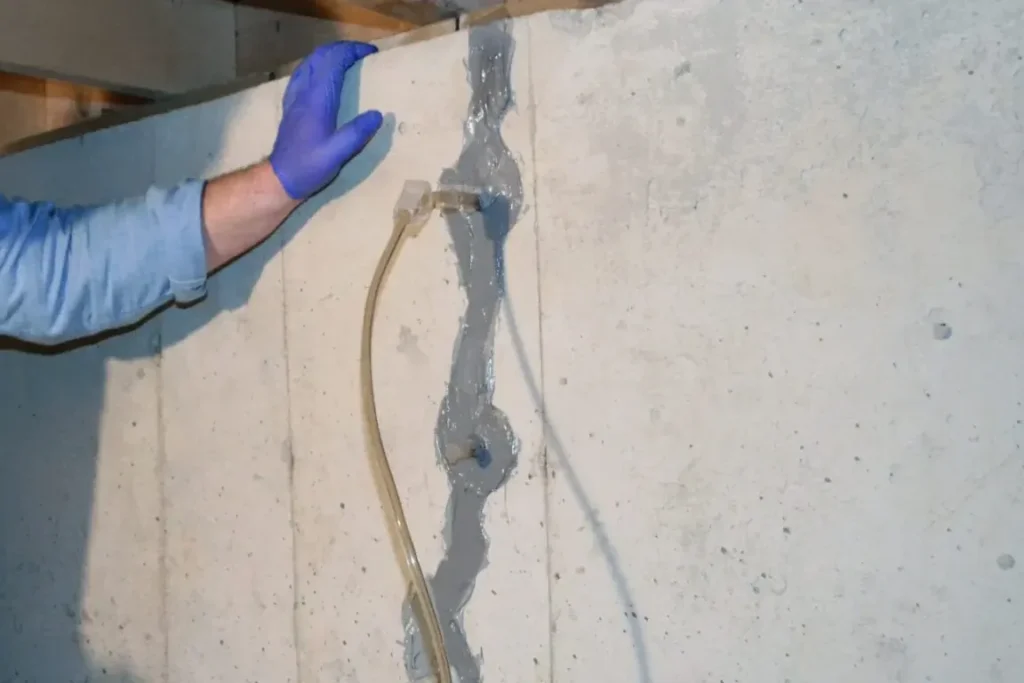
Injection port set along a foundation crack
A sealed crack runs down this poured basement wall, with a port and tubing set in place for the injection. Findlay Creek homes are newer, but foundations on the area’s former wetland clay can still crack as the ground moves.
Parging in Findlay Creek, newer south-end homes on former wetland clay
Ottawa Parging Experts covers Findlay Creek, the south-end Ottawa community that grew from farmland and wetland margins into a full neighbourhood over the 2000s, 2010s, and on into current construction. It sits south of Hunt Club along Bank Street near Leitrim Road, on land bordering the Leitrim wetland, and that origin is not just background colour. The ground here is heavy, water-holding, and it defines how foundations behave.
Homeowners are often surprised to be looking at parging repair on a house that still feels new. It is a fair reaction and there is a straightforward explanation. Production builders apply parging as a single fast pass near the end of construction. It looks flawless at handover, but a thin coat has almost no sacrificial thickness, and the bottom 12 to 18 inches above grade is hit by dozens of freeze-thaw cycles every year. A coat that would last two decades at proper thickness can start crazing and chipping in well under ten years when it goes on thin.
The housing mix is consistent: townhome blocks, semis, and singles on compact lots, mostly poured concrete foundations, built from the early 2000s onward in successive phases. That means whole streets tend to reach the same stage of coating wear at the same time.
What we plan around on Findlay Creek parging jobs
Soil comes first. Much of the Ottawa area sits on Leda clay, a sensitive marine clay left behind by the Champlain Sea, and the south end is squarely in that territory. Clay holds water, swells and shrinks with moisture content, and transmits seasonal movement into a foundation. Layer fresh backfill on top of that, which continues to consolidate for years after a house is finished, and a rigid cement parge coat is being asked to bridge movement it was never designed for. Where a wall is moving or stays persistently damp, flexible acrylic parging is often the right specification instead.
Drainage is second and it is closely related. Settled backfill frequently leaves a shallow trench right against the foundation that collects roof runoff and snowmelt. Downspouts discharging into that trench keep the base of the wall saturated all season. Recoating without fixing that simply resets the clock on the same failure, so we call it out during the inspection even though regrading is not what you asked us about.
Third is the lot geometry. Findlay Creek lots are tight. Side yards between townhomes and closely spaced singles can be very narrow, rear yards are often reached through a garage or a single gate, and fences and air conditioner units sit close to the wall. None of this stops the work, but it determines how material moves and how we protect neighbouring finishes, so we confirm clearance up front.
Parging needs above-freezing temperatures to cure, so work runs spring through fall, roughly late April to early October.
Book a parging inspection in Findlay Creek
Send your Findlay Creek address, the build year, and photos of the affected wall including a low shot right at grade. If there is a gap or dip in the soil beside the foundation, photograph that too.
You will have a written quote within 24 hours. On newer homes the honest answer is frequently a targeted repair rather than a full recoat, and if that is what your wall needs, that is what we will quote.
Our house is only eight years old. Why is the parging chipping already?
Age of the house is not the same as life of the coating. A thin single-pass builder coat has very little sacrificial thickness, and the base of the wall takes dozens of freeze-thaw cycles every winter. Early chipping at grade on a newer south-end home is common rather than unusual.
Can you work between a townhome block where the gap to the neighbour is barely a metre?
Usually yes. Tight side yards mainly change how material gets in and how we protect siding, fencing, and the neighbour's wall. Tell us the clearance when you request the quote and we will confirm approach before the work date.
The ground beside our foundation has dropped a few inches since we moved in. Is that a parging problem?
It is a drainage problem first. Settling backfill creates a trench that holds water against the wall and undermines the base of the coat. Regrading and downspout extensions come before recoating, otherwise the new parging is working against a puddle.
Get my 24-hour quote
Free on-site or photo estimate, written quote within 24 hours.
To provide the best experiences, we use technologies like cookies to store and/or access device information. Consenting to these technologies will allow us to process data such as browsing behaviour or unique IDs on this site. Not consenting or withdrawing consent, may adversely affect certain features and functions.
Functional
Always active
The technical storage or access is strictly necessary for the legitimate purpose of enabling the use of a specific service explicitly requested by the subscriber or user, or for the sole purpose of carrying out the transmission of a communication over an electronic communications network.
Preferences
The technical storage or access is necessary for the legitimate purpose of storing preferences that are not requested by the subscriber or user.
Statistics
The technical storage or access that is used exclusively for statistical purposes.The technical storage or access that is used exclusively for anonymous statistical purposes. Without a subpoena, voluntary compliance on the part of your Internet Service Provider, or additional records from a third party, information stored or retrieved for this purpose alone cannot usually be used to identify you.
Marketing
The technical storage or access is required to create user profiles to send advertising, or to track the user on a website or across several websites for similar marketing purposes.