Free On-Site or Photo EstimateWritten Quote in 24 HoursPatch Repairs $300-$600
Parging Bells Corners
Foundation parging repair and full recoats for Bells Corners bungalows and splits from Lynwood Village to Westcliffe Estates.
Get my 24-hour quote
Tell us your Bells Corners address and where the coating is lifting.
Service availability is confirmed for each request.
Why Bells Corners parging is usually overdue
Original coats past their working life
Most of Bells Corners was built out between the 1950s and the 1970s. Parging has a working life of roughly 10 to 25 years, so an original coat here is on its second or third borrowed lifetime.
Mature trees and risen grade
Seventy years of leaf litter, topsoil top-ups, mulch, and garden beds have raised grade against a lot of these walls, burying the splash zone and keeping the base of the foundation permanently damp.
Block walls under the coating
Concrete block is common in this era of west-end construction, and block telegraphs its joints through a thin coat. Getting the substrate right matters more than the finish texture.
Recent project
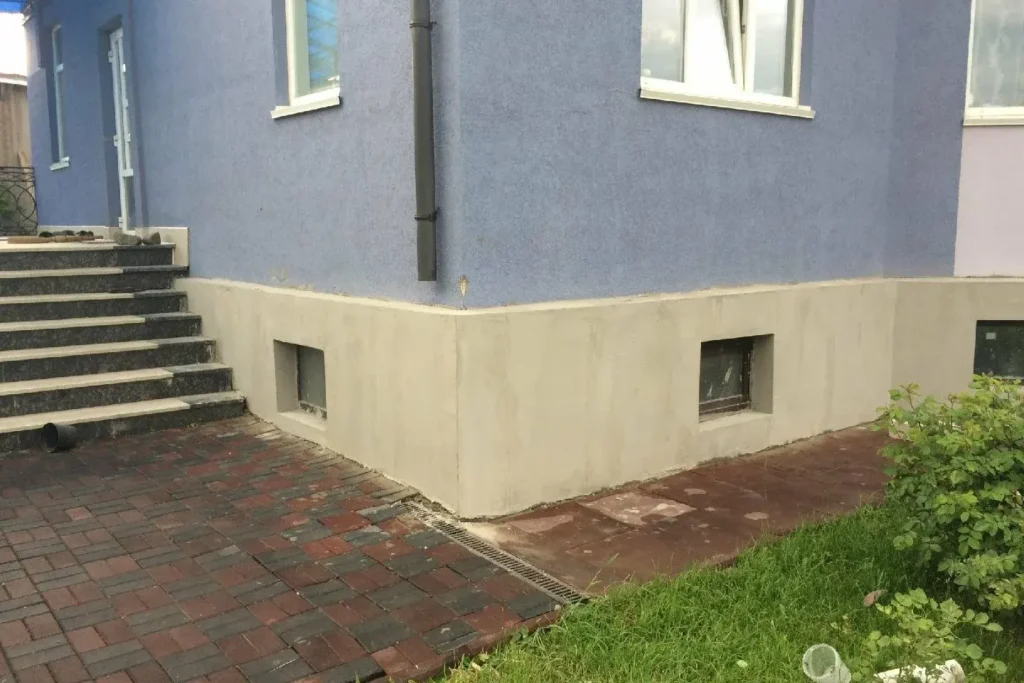
Parging around basement windows
Fresh grey parging covers this raised foundation and returns neatly into each basement window opening, finished down to the paving and the drain channel. Bells Corners is mostly houses from the 1950s to 1970s, and the corners around basement windows are a common place for old parging to crack.
Parging in Bells Corners, a west-end suburb of 1950s to 1970s houses
Ottawa Parging Experts works throughout Bells Corners, and the parging story here is refreshingly consistent compared with most of the city: this is a suburb whose foundations are almost all old enough to need attention. Bells Corners began as one of the older crossroads settlements in the west end, on the historic Richmond Road route out of Ottawa, and it stayed a small village for well over a century before the postwar building boom arrived. From the 1950s through the 1970s it filled in rapidly with the subdivisions people still name today, including Lynwood Village, Arbeatha Park, and Westcliffe Estates, and it was later folded into Nepean before amalgamation brought it into the City of Ottawa.
The practical result is a neighbourhood of bungalows, back-splits, and side-splits on generous lots, with concrete block and early poured foundations underneath. Parging has a working life of roughly 10 to 25 years. An original 1962 coat that has never been redone is not marginal, it is decades past due, and much of what we are asked to look at in Bells Corners is exactly that.
The Greenbelt wraps around much of the community, which keeps the area leafy and the lots mature but also means older infrastructure, older grading, and trees that have had seventy years to grow up against the house.
What we plan around on Bells Corners parging jobs
Risen grade is the defining local issue. Decades of topsoil top-ups, mulch, edging, and garden beds built directly against the foundation have raised the ground on a great many of these houses. The parging that was originally exposed above grade is now partly buried, which means it never dries, and buried coating is the single most reliable way to guarantee an early failure. Where we find it, we will tell you what needs to come away from the wall before a new coat goes on.
The second issue is substrate. Concrete block was widely used in this era, and block behaves differently under parging than poured concrete. Mortar joints telegraph through a thin coat, and where the joints themselves have degraded, coating over them just delays the repair. We check joint condition and bond before quoting rather than after.
Third is the ordinary Ottawa punishment. The bottom 12 to 18 inches above grade is where snow banks against the wall, thaws, soaks in, and refreezes overnight, dozens of times a year. On a coat that has already served fifty or sixty years, that band is usually where the loss is visible.
Access in Bells Corners is generally easy. Wide driveways, real side yards, and detached or attached garages set back from the street make staging straightforward, which is one reason full perimeter work here is often less disruptive than on a tight modern lot.
Book a parging inspection in Bells Corners
Give us your Bells Corners address and photos of the worst elevation, including a low-angle shot showing where the coating meets the ground. If the base is buried in soil or mulch, photograph that too, because it changes the recommendation.
We will come back within 24 hours with a written quote and a straight answer on scope. On houses of this age the honest answer is often a full recoat rather than chasing patches around a perimeter, but if a spot repair genuinely buys you several more years, that is what we will quote.
You can compare those ranges with the full breakdown on our parging cost page. Neighbouring Kanata is part of the same service area.
Bells Corners parging questions
Every house on our Lynwood Village street looks like the parging is failing at the same time. Why?
Because they were built within a few years of each other with the same detailing, and the coating has aged on the same clock. When a whole street reaches the end of a 10 to 25 year cycle together it looks like an outbreak, but it is just synchronised age.
The soil is piled halfway up our foundation from decades of garden beds. Do we have to dig it back before parging?
Usually yes, at least enough to re-establish the base of the wall and a run of exposed foundation above grade. Coating over buried wall traps moisture behind the parging and the new coat will fail early. We will flag it during the inspection rather than after.
Our block foundation shows the joint lines right through the old coat. Is that a defect?
It means the coat is thin or has worn down to close to the block face, which is common on original 1960s work. It is not dangerous on its own, but a coat that thin has little sacrificial material left and is a reasonable candidate for a full recoat.
Get my 24-hour quote
Free on-site or photo estimate, written quote within 24 hours.
To provide the best experiences, we use technologies like cookies to store and/or access device information. Consenting to these technologies will allow us to process data such as browsing behaviour or unique IDs on this site. Not consenting or withdrawing consent, may adversely affect certain features and functions.
Functional
Always active
The technical storage or access is strictly necessary for the legitimate purpose of enabling the use of a specific service explicitly requested by the subscriber or user, or for the sole purpose of carrying out the transmission of a communication over an electronic communications network.
Preferences
The technical storage or access is necessary for the legitimate purpose of storing preferences that are not requested by the subscriber or user.
Statistics
The technical storage or access that is used exclusively for statistical purposes.The technical storage or access that is used exclusively for anonymous statistical purposes. Without a subpoena, voluntary compliance on the part of your Internet Service Provider, or additional records from a third party, information stored or retrieved for this purpose alone cannot usually be used to identify you.
Marketing
The technical storage or access is required to create user profiles to send advertising, or to track the user on a website or across several websites for similar marketing purposes.