Free On-Site or Photo EstimateWritten Quote in 24 HoursPatch Repairs $300-$600
Parging Cumberland
Foundation parging repair and recoating for Cumberland Village and the surrounding rural ward.
Get my 24-hour quote
Tell us your Cumberland address.
Service availability is confirmed for each request.
Local factors we plan around
Rural eastern ward
Cumberland covers a mostly rural area east of the urban core, including Cumberland Village.
Mix of farmhouse and newer builds
Older rural farmhouses sit alongside newer country-lot construction.
Longer travel distances
Rural lot spacing means confirming timing works for your specific location.
Recent project
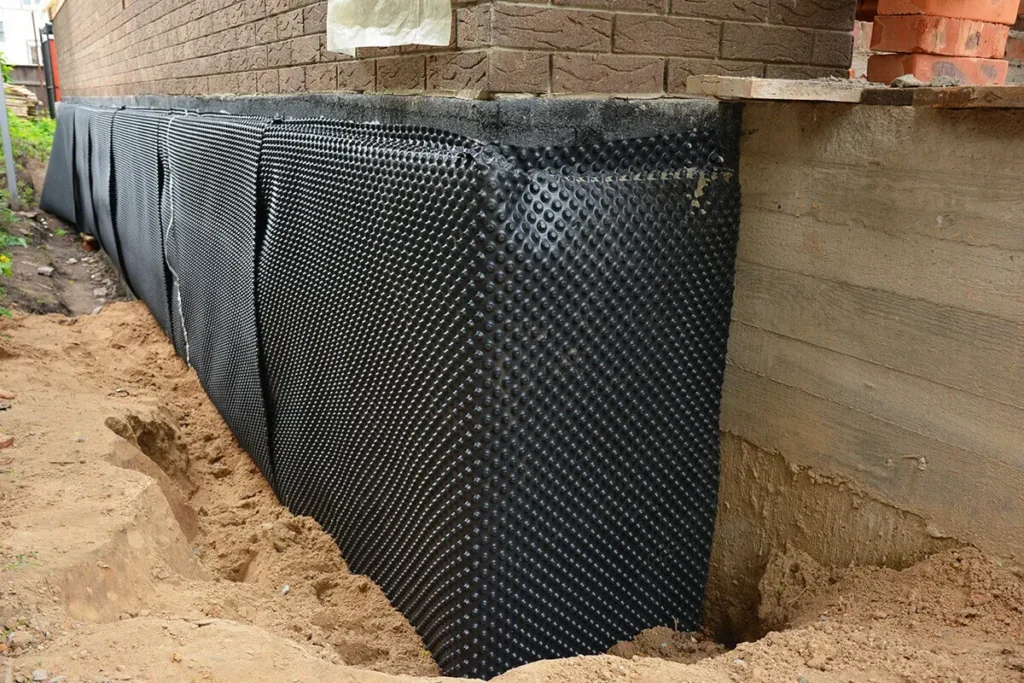
Dimple membrane on a dug-out foundation
This foundation was excavated along the wall and wrapped in a dimpled drainage membrane, which keeps a gap so water drains down instead of sitting against the concrete. Cumberland ranges from older farmhouses to newer rural builds, so each foundation is assessed on its own.
Parging in Cumberland, a rural ward with mixed housing eras
Ottawa Parging Experts works across Cumberland, a mostly rural ward east of Ottawa's urban core that includes Cumberland Village and surrounding country properties. Housing here ranges from older farmhouses with decades of history to newer construction on larger rural lots, which means parging condition varies more by individual property than by neighbourhood-wide construction era.
Older rural foundations sometimes used different construction approaches than standard urban subdivision block, so we assess each Cumberland property on its own during a free inspection rather than assuming a standard profile.
In practice that can mean fieldstone or rubble stone set in a soft lime-based mortar on the oldest farmhouses, concrete block on mid-century rural builds, and poured concrete on newer country-lot homes. The distinction is not academic. A hard modern cement coat applied over soft lime-bedded stone traps moisture in a wall that was built to breathe, and the coat pushes off in plates while the mortar behind it stays wet. Stone walls usually want a softer, more permeable repair approach; block wants a coat that can bridge joints; poured concrete wants surface preparation good enough for the coat to actually bond.
What we plan around on Cumberland parging jobs
Cumberland's rural lot spacing means travel distance and access sometimes factor into scheduling more than they would on a tight urban street – tell us your specific location when requesting a quote.
The eastern lowlands are also Leda clay country. Leda clay is a sensitive marine clay left behind by the Champlain Sea, and it behaves unlike ordinary soil: it holds water, shrinks noticeably through a dry summer, and swells again in autumn. On a rural property with no municipal storm system, that seasonal movement combines with roof water that has nowhere engineered to go. Where a Cumberland wall shows ongoing seasonal movement or stays damp, flexible acrylic parging handles it better than a rigid cement coat, which will simply crack along the same line again.
Grade on country properties is its own subject. Berms, gravel aprons, added topsoil and equipment traffic tend to raise the ground against a foundation over the years, burying the 12 to 18 inches above grade splash zone where parging normally does its work. Buried coating cannot dry between wettings, and with dozens of freeze-thaw cycles a year in this climate, permanently damp material fails quickly.
Equipment access is usually generous out here, but the supporting details are not automatic. Long gravel lanes soften in spring on clay ground, exterior water for mixing is not always available at the wall, and septic beds and well heads need to be known and avoided before anything gets staged. Telling us about those when you book saves a return trip.
Book a parging inspection in Cumberland
Cumberland Village homes and surrounding rural properties book the same way: tell us your specific location and what you're seeing when you request a quote – rural addresses and longer driveways are easy for us to plan around once we know what we're working with. We'll confirm coverage and get a free inspection or photo review scheduled.
For older farm properties, let us know if the foundation uses any non-standard construction so we can prepare accordingly for the visit.
What a Cumberland parging quote covers
A written quote should tell you what is being repaired, why, and what the alternative was. Ours sets out the linear footage being treated, the exposed height of wall, how much existing coating has to come off before anything new goes on, the material chosen and the reason for it, and the price. It arrives within 24 hours of the free on-site or photo estimate.
The numbers themselves stay in defined ranges. A patch is $300 to $600. A moderate repair covering several failed areas is $600 to $1,500. An extensive repair or full recoat is $1,500 to $6,000. A full perimeter recoat or new application is $15 to $30 per linear foot, roughly $2,250 to $4,500 on a typical 150 linear foot home. Rural properties often have longer perimeters than a suburban lot, and walkouts, additions and attached outbuildings add footage, so linear measurement matters more here than a single headline figure.
The quote should also be honest about what is not included. If the real problem is grade or drainage, a parge coat will not fix it, and we would rather say that during the inspection than recoat a wall that is going to fail again. A sound coat on a dry, stable wall should give roughly 10 to 25 years.
Measuring tips and a checklist of what a written quote should include are on our parging cost page. Close by, we cover Orleans and Rockland as well.
Local questions
Do you serve all of Cumberland?
Yes, including Cumberland Village and the surrounding rural ward – tell us your address and we'll confirm.
Do older Cumberland farmhouses need a different approach?
Older rural foundations sometimes have different construction methods than standard subdivision block – we assess each one individually during a free inspection.
Get my 24-hour quote
Free on-site or photo estimate, written quote within 24 hours.
To provide the best experiences, we use technologies like cookies to store and/or access device information. Consenting to these technologies will allow us to process data such as browsing behaviour or unique IDs on this site. Not consenting or withdrawing consent, may adversely affect certain features and functions.
Functional
Always active
The technical storage or access is strictly necessary for the legitimate purpose of enabling the use of a specific service explicitly requested by the subscriber or user, or for the sole purpose of carrying out the transmission of a communication over an electronic communications network.
Preferences
The technical storage or access is necessary for the legitimate purpose of storing preferences that are not requested by the subscriber or user.
Statistics
The technical storage or access that is used exclusively for statistical purposes.The technical storage or access that is used exclusively for anonymous statistical purposes. Without a subpoena, voluntary compliance on the part of your Internet Service Provider, or additional records from a third party, information stored or retrieved for this purpose alone cannot usually be used to identify you.
Marketing
The technical storage or access is required to create user profiles to send advertising, or to track the user on a website or across several websites for similar marketing purposes.