Free On-Site or Photo EstimateWritten Quote in 24 HoursPatch Repairs $300-$600
Parging Embrun
Foundation parging repair, recoating and new application for Embrun homes, village core and new subdivision alike.
Get my 24-hour quote
Tell us your Embrun street and how far up the wall the damage goes.
Service availability is confirmed for each request.
What makes Embrun parging its own job
An 1850s French settlement
Embrun was settled by French Canadian farm families in the 1850s and named for Embrun in France. The parish core holds the oldest and most heavily recoated foundation walls in the village.
Flat Champlain Sea clay plain
The farm country around Embrun is level, poorly drained clay laced with municipal drains and roadside ditches. Wet ground against a wall keeps a cement coat saturated going into freeze-up.
Two decades of subdivision
Most of Embrun's housing went up after the mid-1990s as Ottawa commuters moved out along County Road 3. That original parging is only now reaching the age where the splash zone starts to let go.
Recent project
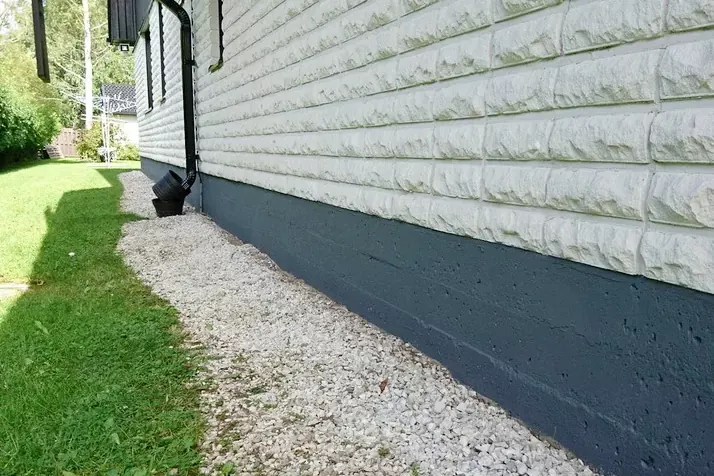
Smooth dark parging below siding
This foundation has a smooth, dark grey parge coat below light siding, with a gravel strip separating it from the lawn. Embrun has grown fast since the mid-1990s, and many of those homes are now due for their first recoat.
Parging in Embrun, farm parish turned commuter village
Ottawa Parging Experts works in Embrun, a village in the Township of Russell about 35 km southeast of downtown Ottawa, reached either off Highway 417 through Vars or straight out County Road 3. Embrun began in the 1850s as a French Canadian farming settlement, took its name from Embrun in the French Alps, and organised itself around its parish. The village stayed small and agricultural, dairy country mostly, for well over a century. It has been strongly francophone the whole time, and still is.
What changed was the commute. From the mid-1990s onward Embrun became one of the fastest-growing communities in Prescott-Russell as families priced out of Ottawa's east end moved out along the county roads. The village core still holds its older stock, but the majority of Embrun houses standing today are subdivision builds from the last thirty years. That single fact shapes most Embrun parging work: we are far more often looking at a first-generation coat starting to break down at grade than at a century wall needing full reconstruction.
What we plan around on Embrun parging jobs
The ground is the main variable. Embrun sits on the flat, poorly drained clay plain left behind by the Champlain Sea, the same sensitive marine clay, often called Leda clay, that runs under much of the Ottawa area. The farmland around the village is cut with municipal drains and deep roadside ditches for exactly that reason. Clay of this kind swells when wet and shrinks when dry, and a foundation riding on it moves a little with the seasons. The concrete rarely cares. A rigid parge coat bonded to the face of it does, and it shows that movement as fine cracking, usually vertical, usually starting low.
Water then finds those cracks. Ottawa area conditions put dozens of freeze-thaw cycles through a wall every year, with cold snaps below -20C, and each cycle levers loose whatever the previous one opened. That is why the failure is almost always in the 12 to 18 inches above grade rather than up under the siding.
Two Embrun-specific things we check before quoting. First, grading: on newer lots the finish grade sometimes sits high against the wall, burying the bottom of the parging and keeping it wet. Second, downspouts, which on tight subdivision lots are often discharging within a foot of the foundation. Both problems will chew through a new coat if they are left alone, and we would rather say so up front than come back in three years.
Material choice follows what we find. A dry, stable wall gets polymer-modified, fibre-reinforced cement parging. A wall that stays damp against soggy clay, or one that is clearly still moving, gets flexible acrylic parging instead.
Book a parging inspection in Embrun
Access in Embrun is straightforward on almost every property, paved drives and open side yards on the newer streets, and we work exterior-only on the great majority of residential jobs, so nobody needs to be home inside. Rural addresses on the concession roads out toward Russell or Vars are no problem either, but tell us the address so we can confirm coverage first.
Send photos or ask for a free on-site look. The written quote comes back within 24 hours with a plain answer on whether this is a patch, a section, or the perimeter. Patch repairs generally run $300 to $600, moderate repairs $600 to $1,500, and extensive repair or a full recoat $1,500 to $6,000. A full perimeter recoat or new application is priced at $15 to $30 per linear foot, roughly $2,250 to $4,500 on a typical 150 linear foot home. Because parging needs above-freezing temperatures to cure, Embrun work runs spring through fall, across an Ottawa frost-free season of about 160 days from late April to early October.
If you want to work out your wall area before calling, our parging cost page shows how. Neighbouring Limoges is part of the same service area.
Embrun parging questions
Embrun sits on heavy clay. Does that show up in the parging or only down at the footings?
It shows up in the parging first. Seasonal shrink and swell in clay moves the wall a hair, and a rigid coat telegraphs that as fine vertical cracking long before anything structural is visible.
Our Embrun lot backs onto a municipal drain and the side yard stays soggy. What would you put on that wall?
On a wall that stays damp or keeps moving we would recommend flexible acrylic parging rather than straight cement, because it tolerates moisture and small movement without debonding.
Most of our street was built around 2004. Should the parging already be failing?
The wall as a whole should be fine at that age, but the lower 12 to 18 inches often is not. That band takes the snow, the roof runoff and the freezing, and it commonly fails a decade or more ahead of the rest.
Get my 24-hour quote
Free on-site or photo estimate, written quote within 24 hours.
To provide the best experiences, we use technologies like cookies to store and/or access device information. Consenting to these technologies will allow us to process data such as browsing behaviour or unique IDs on this site. Not consenting or withdrawing consent, may adversely affect certain features and functions.
Functional
Always active
The technical storage or access is strictly necessary for the legitimate purpose of enabling the use of a specific service explicitly requested by the subscriber or user, or for the sole purpose of carrying out the transmission of a communication over an electronic communications network.
Preferences
The technical storage or access is necessary for the legitimate purpose of storing preferences that are not requested by the subscriber or user.
Statistics
The technical storage or access that is used exclusively for statistical purposes.The technical storage or access that is used exclusively for anonymous statistical purposes. Without a subpoena, voluntary compliance on the part of your Internet Service Provider, or additional records from a third party, information stored or retrieved for this purpose alone cannot usually be used to identify you.
Marketing
The technical storage or access is required to create user profiles to send advertising, or to track the user on a website or across several websites for similar marketing purposes.