Free On-Site or Photo EstimateWritten Quote in 24 HoursPatch Repairs $300-$600
Parging Constance Bay
Foundation parging repair and recoating for Constance Bay homes on the sand hills above the Ottawa River.
Get my 24-hour quote
Tell us your Constance Bay street and whether the house started out as a cottage.
Service availability is confirmed for each request.
Constance Bay conditions we account for
Sand, not Leda clay
Constance Bay sits on deep post-glacial sand rather than the marine clay under much of Ottawa, so lateral pressure and clay heave are less of a story here than splash, wind-driven sand, and fast-draining backfill.
Ottawa River high water
The spring freshet is a real factor on the low-lying streets, and the 2017 and 2019 river floods left walls saturated for weeks. Foundations that stay damp are candidates for flexible acrylic parging rather than a rigid cement coat.
Cottages converted to year-round homes
Much of the community began as seasonal river cottages from the interwar decades onward, so we see shallow block walls, piers, crawl space skirts, and additions poured decades apart on one house.
Recent project
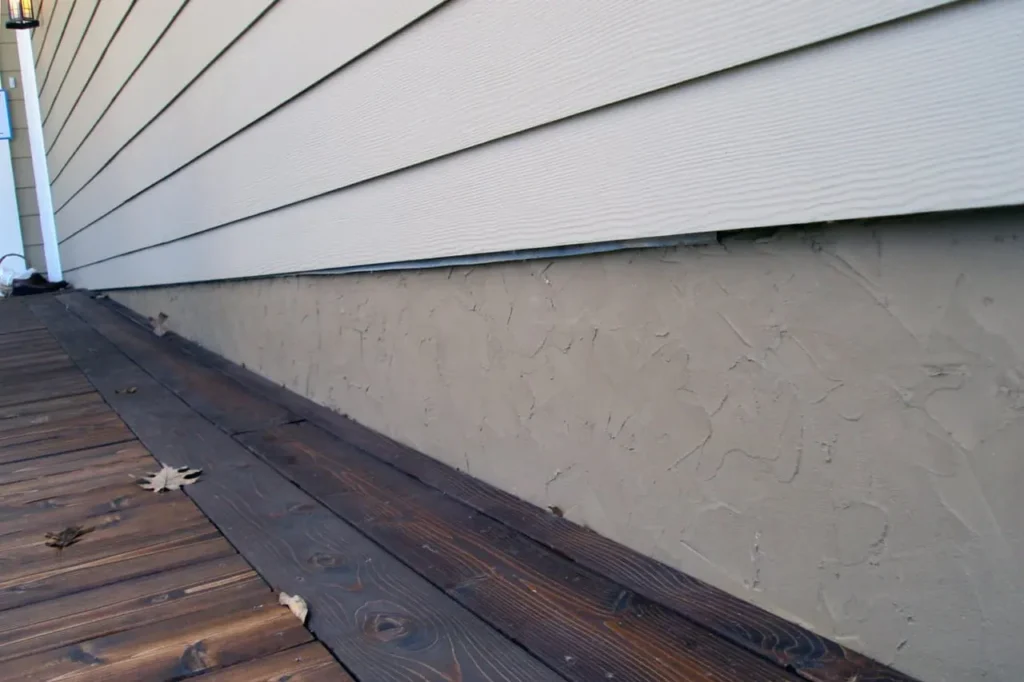
Textured parging beside a deck
A light, textured parge coat covers the foundation between the siding and a wooden deck that runs right up to the wall. Many Constance Bay homes started as cottages, and tight spots like this one, where a deck meets the foundation, need careful handwork.
Parging in Constance Bay, sand hills and converted river cottages
Ottawa Parging Experts covers Constance Bay, the community on the Ottawa River in the far west end of the city where the foundations tell a very particular story. The area began filling in as a seasonal cottage community in the first half of the twentieth century, on narrow lots laid out along a grid of small streets running back from the water. Over the decades most of those cottages were winterized, expanded, or replaced outright, so what stands today is largely a year-round community built on top of seasonal bones.
That history is the whole reason parging here is not routine. A house may have a shallow concrete block wall from the 1950s under the original section, a poured addition from the 1980s, and a crawl space skirt somewhere in between, all needing the same coating to look continuous. Different substrates, different ages, different amounts of movement, one wall.
The ground is unusual too. Constance Bay sits on deep sand left behind after the Champlain Sea, the same deposit that gives the neighbouring Torbolton Forest its dunes and pine barrens. Much of the Ottawa area sits on Leda clay, a sensitive marine clay from the same period, but not this pocket. Sand drains quickly and puts far less lateral pressure on a foundation, which is good news, but it also means grade against a wall shifts over time and blowing sand abrades an exposed coating.
The drive is roughly 45 km northwest of downtown Ottawa, out Dunrobin Road and in along Constance Bay Road, so we treat it as a planned trip rather than a quick call.
What we plan around on Constance Bay parging jobs
Water is the first item. The Ottawa River freshet matters on the lower-lying streets, and the 2017 and 2019 flood events left foundations in parts of the community saturated for extended periods. A wall that has been wet for weeks and then goes through a winter is exactly the situation where a rigid cement parge coat releases in sheets. Where a wall stays damp or shows a pattern of seasonal wetting, flexible acrylic parging is usually the better call, and we will say so.
Second is what is actually under the coating. On converted cottages we check block condition, mortar joints, and any earlier repair layers before quoting, because a fresh coat over failing block is a cosmetic fix with a short life. Skirting around crawl spaces gets the same look: if the backing is not sound, coating it solves nothing.
Third is the lot itself. Streets are narrow, lots are close together, and mature pine cover keeps some walls shaded and slow to dry. Access is generally fine but it is tight, so we confirm staging before the day.
Book a parging inspection in Constance Bay
Send your Constance Bay address with photos of the wall from straight on and from low down at the base, plus a note on whether the house was originally seasonal. That tells us more than almost anything else about what we are likely to find.
You get a written quote within 24 hours, and an honest read on whether this is a patch, a section repair, or a full recoat. If the coat is sound and the only issue is staining, we will tell you it can wait.
The parging repair page walks through what a proper repair involves. For a closer look at how quotes are built, see the parging cost page. Neighbouring Fitzroy Harbour is part of the same service area.
Constance Bay parging questions
Our place is a 1950s cottage on block piers with a skirt around the crawl space. Is that parge-able?
Often yes, and a skirt is one of the more common requests out here. The important part is checking whether the block and the skirt framing are sound first, because a coating over crumbling block or rotted backing just hides the problem for a season.
The river came up to the foundation a few years back. Should we recoat now or wait?
Look at bond first. Tap the coat with a knuckle and listen for hollow spots, which mean it has released from the wall. Saturation followed by a freeze is what pops a coat off, so hollow or drummy areas are worth addressing rather than leaving to peel through another winter.
Does sandy ground mean the parging lasts longer here than in the city?
Not really. Sand drains well, which helps, but the bottom 12 to 18 inches above grade still gets soaked and frozen repeatedly, and blowing sand is abrasive on an exposed coat. Expect the same rough 10 to 25 year working life.
Get my 24-hour quote
Free on-site or photo estimate, written quote within 24 hours.
To provide the best experiences, we use technologies like cookies to store and/or access device information. Consenting to these technologies will allow us to process data such as browsing behaviour or unique IDs on this site. Not consenting or withdrawing consent, may adversely affect certain features and functions.
Functional
Always active
The technical storage or access is strictly necessary for the legitimate purpose of enabling the use of a specific service explicitly requested by the subscriber or user, or for the sole purpose of carrying out the transmission of a communication over an electronic communications network.
Preferences
The technical storage or access is necessary for the legitimate purpose of storing preferences that are not requested by the subscriber or user.
Statistics
The technical storage or access that is used exclusively for statistical purposes.The technical storage or access that is used exclusively for anonymous statistical purposes. Without a subpoena, voluntary compliance on the part of your Internet Service Provider, or additional records from a third party, information stored or retrieved for this purpose alone cannot usually be used to identify you.
Marketing
The technical storage or access is required to create user profiles to send advertising, or to track the user on a website or across several websites for similar marketing purposes.