Brick pattern cut into a new parge coat
A worker cuts a brick pattern into a fresh parge coat with a trowel along the base of a wall. North Gower sits on the Rideau clay plain, where foundation coats take a lot of seasonal ground movement.
Much of the ground south of the city is Leda clay left behind by the Champlain Sea. It swells and shrinks with the seasons, which reopens the same foundation cracks year after year.
North Gower grew as a township crossroads and fairground village, so its older stock is brick and stone farmhouses and village homes on rubble stone or early block cellars.
Many properties sit well back from the road on large lots. Access is generally easy, but we plan material staging and the walk from the truck to the wall before the day of work.
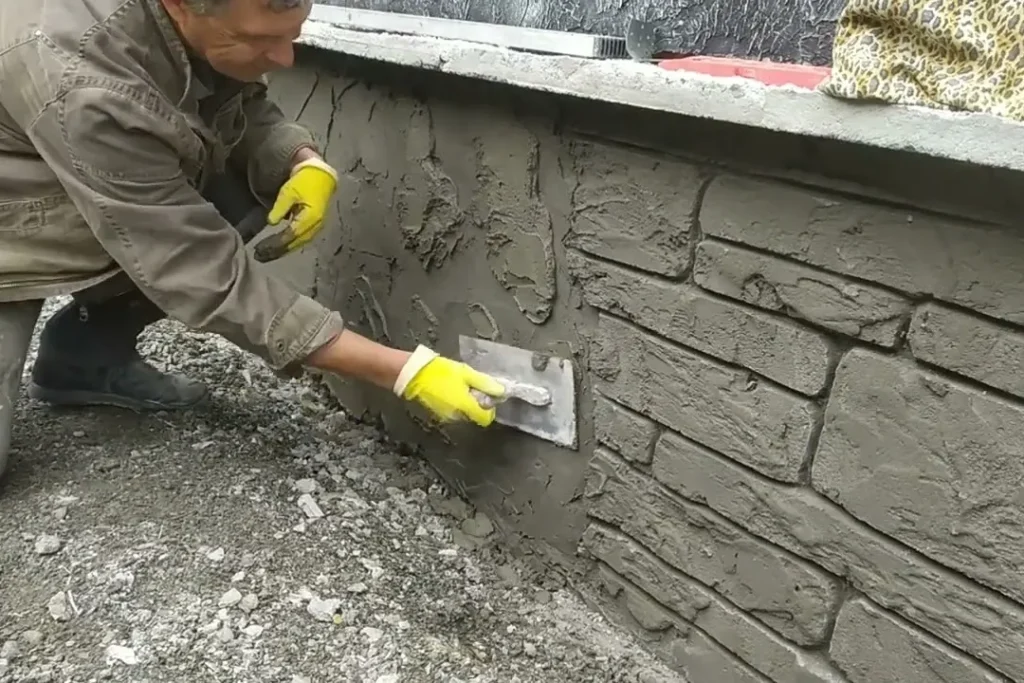
A worker cuts a brick pattern into a fresh parge coat with a trowel along the base of a wall. North Gower sits on the Rideau clay plain, where foundation coats take a lot of seasonal ground movement.
Ottawa Parging Experts covers North Gower, the village roughly 35 kilometres south of downtown Ottawa just off Highway 416. It began in the early 1800s as a crossroads settlement in the old township of the same name, served the farms around it for well over a century, and was folded into the City of Ottawa in the 2001 amalgamation after decades as part of Rideau Township. The fairground tradition and the agricultural feel of the place are still obvious, and so is the housing that goes with it: brick and stone farmhouses, modest village houses, and newer rural builds on large lots with their own wells and septic systems.
Foundation types follow the same split. Older village and farm properties commonly sit on rubble stone or early concrete block cellars, sometimes with more than one generation of parging on them. Rural infill from the last few decades is block or poured concrete carrying a builder's coat. What ties both together in North Gower is not the house at all. It is the ground underneath it.
This is clay country. Much of the land south of Ottawa lies on Leda clay, the sensitive marine clay left by the Champlain Sea, and it does not sit still. It takes up water in spring and gives it back through a dry summer, and the volume change moves foundations enough to reopen fine cracks in any rigid coating laid over them. If you have patched the same crack three times and it keeps coming back in the same line, the coating is not the problem. The soil is telling you it needs a material that can stretch, which is where flexible acrylic parging earns its place over a hard cement mix.
Mature trees make it sharper. A big maple or willow close to the house draws a large volume of water out of clay during a dry August, and the resulting shrinkage tends to concentrate on that side of the building. We look for cracking that is heavier on one elevation, because that pattern points at soil movement rather than at a bad coat.
Grade is the other recurring North Gower issue. On properties where gardens have been topped up year after year, the bottom of the parging ends up buried. Buried coating never dries, it wicks moisture upward, and it fails from underneath while the visible portion still looks respectable. Pulling grade back off the wall before recoating is often the single most useful thing done on these jobs.
Then there is the ordinary regional load. The 12 to 18 inches above grade takes the splash and the snow pile, it goes through dozens of freeze-thaw cycles a year, and the coating has to cure above freezing, so work runs through the frost-free season of roughly late April to early October.
Send the address, the approximate age of the house, and a description of what the wall is doing. We will arrange a free on-site or photo estimate and get a written quote back to you within 24 hours. On rural properties it helps to mention the driveway length and any gate or soft ground, so we can plan how material gets to the wall.
Scope-wise, we will tell you honestly where you stand. A contained repair is normally $300 to $600 and can usually wait for settled weather. A moderate repair across a larger area runs $600 to $1,500. Extensive repair or a full recoat is $1,500 to $6,000, or $15 to $30 per linear foot, which is about $2,250 to $4,500 on a typical 150 linear foot home. With a service life around 10 to 25 years, plenty of North Gower walls are simply due rather than damaged.
Our parging cost guide explains what moves a quote up or down. We also work in nearby Kars and Richmond.
Yes, quite a lot. Buried coating stays wet, and it wicks moisture up into the wall above it. Where grade has crept up against the house we will usually recommend pulling it back before recoating, otherwise the new coat starts its life saturated.
Often. Sensitive marine clay shrinks in a dry summer and takes up water again in spring, and that seasonal movement reopens hairline cracks in a rigid coating. On walls that move, flexible acrylic parging holds up better than a hard cement mix.
They can be. Large trees pull a lot of moisture out of clay in a dry stretch, which increases seasonal shrinkage right where the roots are. It shows up as cracking concentrated on one side of the house rather than all around.