Parge coat on an excavated block foundation
With the soil dug back along the wall, a grey parge coat covers this block foundation from the trench up to the siding line. Carleton Place homes get the same full-height coat when an old one has failed.
Homes in the older Carleton Place core have often been parged three or four times over a century. The failure is usually one old coat letting go of another rather than the wall itself giving way.
The town sits where the Mississippi River leaves Mississippi Lake, so waterfront and low-lying lots deal with spring high water and a wetter base of wall than properties up the hill.
Fast subdivision growth along the Highway 7 corridor means many newer Carleton Place homes carry a thin original scratch coat that starts flaking well inside its first decade.
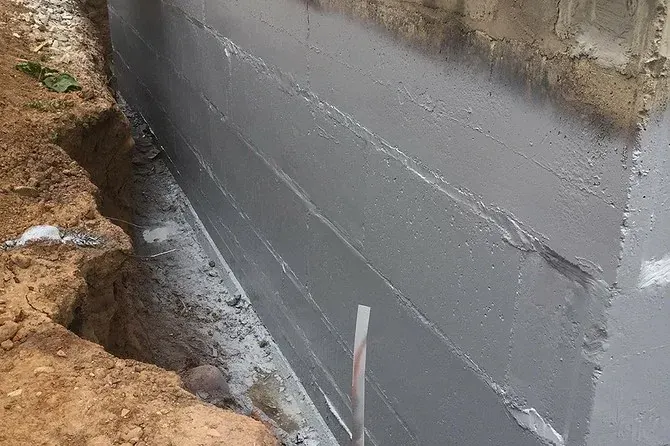
With the soil dug back along the wall, a grey parge coat covers this block foundation from the trench up to the siding line. Carleton Place homes get the same full-height coat when an old one has failed.
Ottawa Parging Experts works throughout Carleton Place, the Lanark County town on the Mississippi River about 45 kilometres west of Ottawa along Highway 7. Settlement began here in 1819 with Scottish arrivals who took up land at the outlet of Mississippi Lake, and the place eventually took its name from Carleton Place in Glasgow. Water power built the town first, in woollen and lumber milling, and the railway built it a second time when Carleton Place became an important point on the Canadian Pacific line and the shops and railway housing that came with it.
Both of those eras are still standing. The Bridge Street commercial core and the streets around it hold stone and brick buildings from the mill years, backed by a large stock of modest railway-era houses on smaller lots. Those homes typically sit on fieldstone or early block cellars that have been coated, recoated and patched several times over the last century. Then there is the third Carleton Place, the commuter town, with a substantial amount of subdivision construction added in recent decades as people traded the Ottawa drive for a smaller town. Those newer foundations are block or poured concrete with a builder's parge skirt.
On the older houses the problem is rarely the wall. It is the stack of coatings on it. A lime-based coat from a century ago, a cement coat over that from the 1960s, and a modern patch on top of both do not move together, and the bond between layers fails long before the substrate does. We sound the whole elevation with a hammer first, because hollow areas can look perfectly solid until you tap them. Anything drummy comes off; anything still bonded gets feathered into. If most of the surface is hollow, taking the elevation back to sound material and recoating it once is the cheaper decision over five years than a patch every spring.
On the newer side of town, the failures are ordinary splash-zone failures. The band roughly 12 to 18 inches above grade takes the plough pile, the melt cycle and the rain kicking off the ground, and that is where a thin factory-schedule coat gives out first. This market goes through dozens of freeze-thaw cycles a year, and each of those cycles works water further behind the coating.
Water is the other Carleton Place variable. The town straddles the river where it leaves Mississippi Lake, and low riverside and lakeside lots see high spring water and slower drying at the base of the wall. On those walls we look at where downspouts and sump lines discharge before we specify anything, and we lean toward flexible acrylic parging where the wall stays damp. Cement or acrylic, the coating needs above-freezing temperatures to cure, so the working season runs spring through fall.
Give us the address, the rough age of the house, and a couple of photos if you have them, and we will set up a free on-site or photo estimate and put a written quote in your hands within 24 hours. Photos taken on a dry day tell us more than photos in the rain, and a shot along the wall at ground level shows the grade relationship that most damage traces back to.
We will be straight about scope. Localized damage on a sound wall is generally patch work at $300 to $600. One deteriorated elevation usually lands in the $600 to $1,500 range. A full recoat of a Carleton Place home is $1,500 to $6,000 depending on condition and access, or $15 to $30 per linear foot, about $2,250 to $4,500 on a typical 150 linear foot house. With a working life of roughly 10 to 25 years, a coat applied when the current owners moved in during the 1990s is due regardless of how it looks from the street.
See how a parging repair is scoped before any coating comes off. The parging cost page covers what changes the price, from removal to access. We also work in nearby Almonte and Stittsville.
Not always. We sound the wall and remove whatever is hollow or loose, then feather into the sections still bonded. If most of the surface rings hollow, taking it back and recoating the elevation is usually cheaper than chasing patches every spring.
It is common. A thin original coat with a weak bond gives up early, especially in the splash zone. It is not usually a structural sign, but it does mean the coating needs to be redone properly rather than patched.
Often, yes. If meltwater or downspout discharge is running against the base of the wall, a new coat will fail in the same band it failed in before. We will say so in the quote rather than coat over the problem.