Free On-Site or Photo EstimateWritten Quote in 24 HoursPatch Repairs $300-$600
Parging Stittsville
Foundation parging repair and recoating for Stittsville homes, from the historic village core to newer subdivisions.
Get my 24-hour quote
Tell us your Stittsville address.
Service availability is confirmed for each request.
Local factors we plan around
Former village, now a suburb
Stittsville's historic Main Street core sits alongside rapid subdivision growth from the 2000s and 2010s.
Mixed foundation ages
Older village-core homes carry different parging history than the newer subdivisions surrounding them.
Larger rural-edge lots
Properties near Stittsville's rural fringe sometimes have larger setbacks and different grading conditions.
Recent project
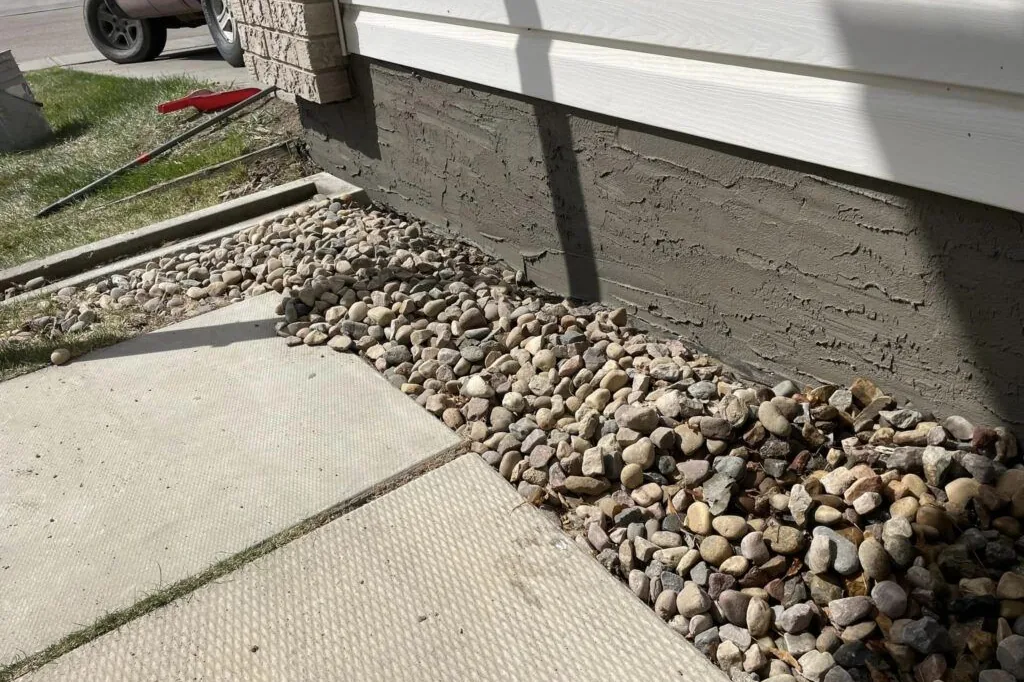
Textured parging above a river-rock bed
A textured grey coat runs along this foundation, from the bottom of the siding down to a river-rock bed beside the walkway. Stittsville work ranges from coats like this on newer subdivision homes to recoats on older village-area houses.
Parging in Stittsville, a village core surrounded by new growth
Ottawa Parging Experts works across Stittsville, a former independent village that's grown into one of Ottawa's fastest-expanding west-end suburbs while its historic Main Street core remains recognizably older. That layered history means two very different parging situations exist within the same community – older village-area homes with decades of original coating, and newer subdivision construction from the 2000s and 2010s that's still within a typical parging lifespan.
We assess Stittsville properties individually rather than assuming condition based on the surrounding development, since a village-core home and a new-build a few streets away can be at completely different points in the same 10 to 25 year parging cycle.
The two situations are not just different ages, they are different walls. Older homes near the Main Street core can sit on stone rubble or early block foundations, where the parge coat is genuinely doing structural housekeeping: it covers irregular material, closes gaps and sheds water off a surface that was never flat to begin with. Those walls reward a soft, forgiving coating and punish a hard, brittle one, because a rigid cement skin over an irregular substrate tends to crack along the substrate's own lines. Subdivision homes from the 2000s onward are poured concrete with a smooth face, where the whole question is bond to a dense surface rather than coverage of an uneven one.
What we plan around on Stittsville parging jobs
Properties nearer Stittsville's rural edge sometimes carry larger lots and different grading than tighter subdivision streets, which factors into any drainage-related assessment.
Ground conditions on the west side of the city are variable in a way that matters here. Some Stittsville-area ground drains fast through sand and gravel, and in parts of the west end bedrock sits relatively close to surface, which means less soil depth to absorb meltwater and more of it running along the top toward whatever it meets. Elsewhere the region's Leda clay, the sensitive marine clay left by the Champlain Sea, holds water at the wall for weeks. Two homes a few streets apart can have genuinely different splash-zone exposure, and that band, the 12 to 18 inches directly above grade, is where parging fails first almost everywhere in this climate. Freeze-thaw cycles run into the dozens each year, with cold snaps below -20C, mostly in January.
Access splits the same way the housing does. Newer subdivision streets are straightforward, with driveways close to the working face. Rural-edge properties have long gravel drives, generous setbacks and sometimes a septic bed to keep equipment off, so we plan where the truck sits and how far material has to travel before the day starts. Village-core lots are the tightest, with older structures close to the property line and limited room to stage.
Book a parging inspection in Stittsville
Homes near the historic Main Street core and in Stittsville's newer subdivisions book the same way: tell us your address and what you're seeing and we'll confirm coverage and get a free inspection or photo review scheduled. Older village-area homes and newer builds are assessed the same way – by actual wall condition, not assumed age.
Stittsville's continued growth means we regularly work in newer phases alongside active construction nearby, so let us know if site access involves any construction-related considerations when you book your visit.
What a Stittsville parging quote covers
The estimate is free, on site or from photos, and the written quote follows within 24 hours. What it sets out is the scope, not just a number: how much of the existing coat has to come off before anything new goes on, what the substrate underneath turns out to be, which material we are recommending and why, and how many linear feet of wall are involved.
Material choice is part of the quote because it is a real decision. Polymer-modified, fibre-reinforced cement parging is the standard for a sound wall in a normally drained location. Flexible acrylic parging is what we recommend for walls that move seasonally or stay damp, which on Stittsville jobs tends to mean older village-core foundations and low-lying rural-edge lots.
Pricing lands in known bands. A patch is $300 to $600. A moderate repair is $600 to $1,500. Extensive work or a full recoat is $1,500 to $6,000. A full perimeter recoat or a first application is $15 to $30 per linear foot, roughly $2,250 to $4,500 on a typical 150 linear foot home. If the wall is sound and the damage is cosmetic, the quote will say the work can wait, and that is a legitimate outcome of an inspection.
Yes, including the historic village core and surrounding subdivisions – tell us your address and we'll confirm.
Is a Stittsville village-core home different to work on than a new subdivision home?
The process is the same, but older village-core homes are more likely to need a repair assessment for aging original parging, while newer subdivision homes are more often first-time installation or early recoating.
Get my 24-hour quote
Free on-site or photo estimate, written quote within 24 hours.
To provide the best experiences, we use technologies like cookies to store and/or access device information. Consenting to these technologies will allow us to process data such as browsing behaviour or unique IDs on this site. Not consenting or withdrawing consent, may adversely affect certain features and functions.
Functional
Always active
The technical storage or access is strictly necessary for the legitimate purpose of enabling the use of a specific service explicitly requested by the subscriber or user, or for the sole purpose of carrying out the transmission of a communication over an electronic communications network.
Preferences
The technical storage or access is necessary for the legitimate purpose of storing preferences that are not requested by the subscriber or user.
Statistics
The technical storage or access that is used exclusively for statistical purposes.The technical storage or access that is used exclusively for anonymous statistical purposes. Without a subpoena, voluntary compliance on the part of your Internet Service Provider, or additional records from a third party, information stored or retrieved for this purpose alone cannot usually be used to identify you.
Marketing
The technical storage or access is required to create user profiles to send advertising, or to track the user on a website or across several websites for similar marketing purposes.