Free On-Site or Photo EstimateWritten Quote in 24 HoursPatch Repairs $300-$600
Parging Winchester
Foundation parging repair and recoating for Winchester village and the North Dundas farm country around it.
Get my 24-hour quote
Tell us your Winchester address and how the base of the wall looks after the melt.
Service availability is confirmed for each request.
Winchester parging conditions we plan for
Drifting off open fields
Winchester sits in flat, open farm country, so wind pushes snow into long drifts against exposed walls. Coating buried under a drift until April spends weeks wet, then freezes again.
Flat land, slow drainage
The South Nation lowland drains slowly and relies heavily on ditching and tile. Water that lingers beside a foundation ends up in the splash zone, which is where parging fails first.
Village brick and farm stone
The village core holds late 19th century brick houses from the railway and dairy years, while the concessions around it carry stone farmhouses and outbuildings with much older wall construction.
Recent project
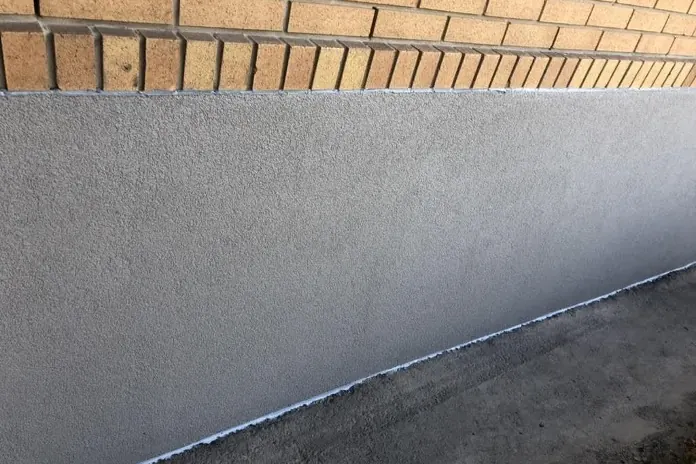
Fine-textured parging below a brick wall
A fresh, fine-textured grey parge coat covers the foundation below the brick, finished to a straight line along the bottom course. Winchester’s Victorian brick homes and farm properties get the same care at that brick-to-foundation line.
Parging in Winchester, dairy country on the South Nation lowland
Ottawa Parging Experts works south into Winchester, the North Dundas village roughly 60 kilometres from Ottawa down the Highway 31 corridor that starts as Bank Street. Winchester grew as a service centre for the surrounding farms in the 1800s, took a step up when the railway came through the area late in that century, and settled into its long role as a hub of Eastern Ontario dairy country, with a district hospital that still draws people in from the concessions around it. The result is a village with a solid core of Victorian brick housing, ringed by farm properties whose houses and outbuildings are often older still.
For parging, the interesting part is the range of wall types in a small area. In the village you find late 19th century brick homes on rubble stone cellars alongside mid-century and modern infill on block. On the farms you find stone walls with lime mortar, block additions from the 1960s and 70s, and poured concrete on the newest builds, sometimes all on one property. We price and specify by wall, not by address.
What we plan around on Winchester parging jobs
The landscape here is flat and open, and that has two direct consequences. The first is snow. With few windbreaks between fields, snow drifts long and deep against whichever elevation faces the prevailing wind, and a wall buried in a drift stays damp and shaded well into spring. Wet freezing is harder on a coating than dry cold, which is why the drifted side of a Winchester house usually gives out years ahead of the sheltered side.
The second is drainage. The South Nation lowland is flat enough that the whole area depends on ditching and tile to move water, and where surface water lingers next to a house it soaks the base of the foundation. That is the 12 to 18 inches above grade that fails first on almost every foundation in this region, and dozens of freeze-thaw cycles a year work on exactly that band. Cold snaps in this part of Eastern Ontario drop below -20C, mostly in January, and each one puts pressure behind whatever water the coating absorbed.
On the older stone walls we take a different approach from the block and poured ones. Dense cement over stone bedded in lime mortar seals a wall that has always dried through its face, and the trapped moisture then works on the stone and the joints instead. Where a coating suits the wall we keep the detail breathable, and we use flexible acrylic parging on walls that stay damp or move. Whatever the material, it needs above-freezing temperatures to cure, so the season runs spring through fall.
Book a parging inspection in Winchester
Send us the address, the age of the building, and what the wall looks like once the snow is off it. We will set up a free on-site or photo estimate and have a written quote to you within 24 hours. If you are sending pictures, photograph the drifted elevation as well as the one that bothers you, because those two often tell different stories.
We will also say when something can wait a season. A small failed area on an otherwise sound wall is patch work at $300 to $600. A moderate repair covering a larger stretch runs $600 to $1,500. Extensive repair or a full recoat lands between $1,500 and $6,000, or $15 to $30 per linear foot, roughly $2,250 to $4,500 on a typical 150 linear foot home. Given a working life of about 10 to 25 years, a Winchester wall that has not been touched since the 1990s is due on age alone, drift or no drift.
Our parging cost guide explains what moves a quote up or down. Neighbouring Chesterville and Kemptville are part of the same service area.
Winchester parging questions
Snow drifts sit against our foundation all winter. What is that doing to the parge coat?
A drift keeps the wall wet and shaded, so the coating goes through repeated wet freezing rather than drying out between cold snaps. That is harder on parging than cold alone, and it is why the drifted elevation usually fails years before the others.
Our farmhouse has a stone cellar and a newer block addition. Can both be coated the same way?
Usually not. Old stone laid in lime mortar needs to breathe, so a rigid cement coat can trap moisture and damage the stone, while a block addition takes a polymer-modified cement parging without complaint. We often specify two different treatments on the same house.
Is Winchester too far south of Ottawa for a site visit?
It is within the range we travel down the Highway 31 corridor, but availability is confirmed for each request rather than assumed. If a site visit does not suit the timing, a photo estimate gets you the same written quote.
Get my 24-hour quote
Free on-site or photo estimate, written quote within 24 hours.
To provide the best experiences, we use technologies like cookies to store and/or access device information. Consenting to these technologies will allow us to process data such as browsing behaviour or unique IDs on this site. Not consenting or withdrawing consent, may adversely affect certain features and functions.
Functional
Always active
The technical storage or access is strictly necessary for the legitimate purpose of enabling the use of a specific service explicitly requested by the subscriber or user, or for the sole purpose of carrying out the transmission of a communication over an electronic communications network.
Preferences
The technical storage or access is necessary for the legitimate purpose of storing preferences that are not requested by the subscriber or user.
Statistics
The technical storage or access that is used exclusively for statistical purposes.The technical storage or access that is used exclusively for anonymous statistical purposes. Without a subpoena, voluntary compliance on the part of your Internet Service Provider, or additional records from a third party, information stored or retrieved for this purpose alone cannot usually be used to identify you.
Marketing
The technical storage or access is required to create user profiles to send advertising, or to track the user on a website or across several websites for similar marketing purposes.