Free On-Site or Photo EstimateWritten Quote in 24 HoursPatch Repairs $300-$600
Parging Nepean
Foundation parging repair and recoating for Nepean homes, from Merivale to Bells Corners.
Get my 24-hour quote
Tell us your Nepean address.
Service availability is confirmed for each request.
Local factors we plan around
Former independent city
Nepean was its own city until Ottawa's 2001 amalgamation, with housing stock spanning mid-century to modern construction.
Merivale corridor mix
A blend of established residential streets and commercial-adjacent properties along the Merivale Road corridor.
Wide range of foundation ages
Bells Corners and older Nepean streets carry parging well past typical replacement age in many cases.
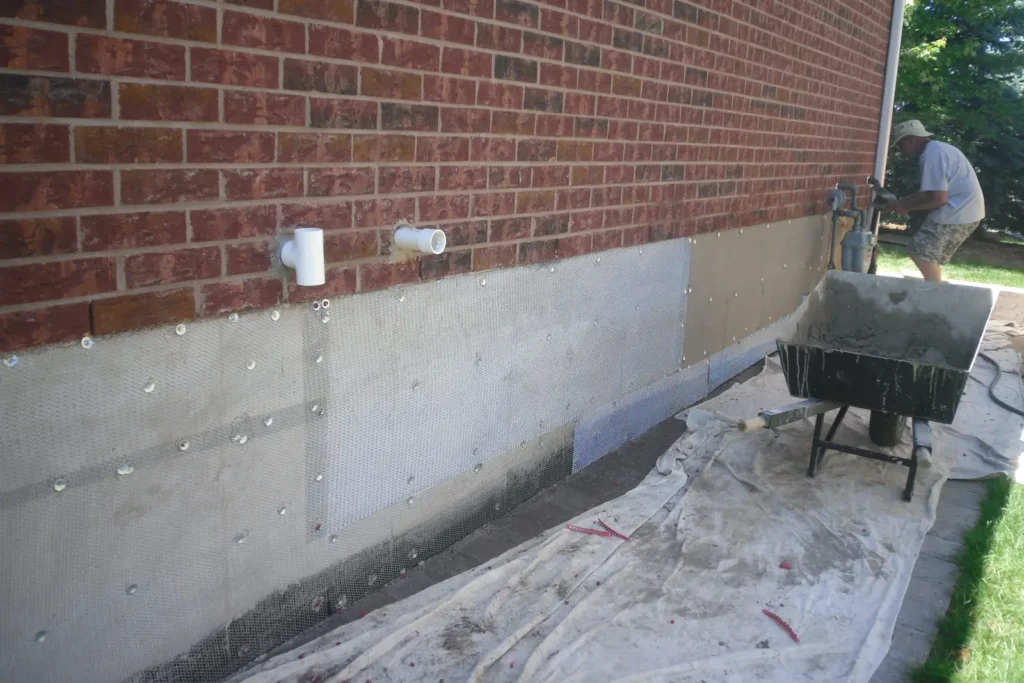
Recent project
Wire mesh going on before a new parge coat
On this brick home, wire mesh is fastened to the bare foundation so the new parge coat has something to grip. Older Nepean walls where the original parging has let go need this full rebuild rather than a patch.
Parging in Nepean, housing that carries decades of history
Ottawa Parging Experts works across Nepean, an area that operated as its own independent city until Ottawa's 2001 municipal amalgamation folded it into the current city structure. That civic history left behind a wide range of housing stock, from established mid-century streets to newer construction closer to Barrhaven's border – which is part of why parging condition varies so much from one Nepean block to the next.
The Merivale Road corridor in particular mixes long-standing residential streets with commercial-adjacent properties, and older sections of Bells Corners carry original parging that's frequently well past a typical 10 to 25 year lifespan. We treat every Nepean inspection individually rather than assuming condition based on the surrounding neighbourhood's general age.
The mid-century part of that stock is the technically interesting part. Bungalows and split-levels from the 1950s and 60s were commonly built on concrete block, and a block foundation behaves differently under a parge coat than a poured wall does. Mortar joints are softer than the block faces around them, so they erode first, and once the coating over a joint fails, water has a continuous horizontal path to travel. On those walls we are usually looking at whether the joints themselves still have body left, not just whether the surface coat is intact, because a cosmetic recoat over eroded joints buys a short and misleading reprieve.
Nepean's oldest streets also tend to show very little foundation above grade. A low mid-century bungalow may have only a foot or so of exposed wall, which sounds like less to maintain and is actually the opposite: the entire visible surface sits inside the 12 to 18 inch splash zone above grade, the band where snow banks against the wall, melts, soaks in and refreezes. There is no clean upper section to fall back on. The area goes through dozens of freeze-thaw cycles a year, and January cold snaps drop below -20C.
What we plan around on Nepean parging jobs
Nepean's mature tree cover and established landscaping on older streets sometimes means working around mature plantings close to the foundation – something we account for when scoping access.
Sixty years of landscaping has a second effect beyond access. Successive owners add topsoil, mulch and bed edging against the house, and grade creeps upward a few centimetres at a time until soil is sitting against parging that was never meant to be buried. Buried coating stays damp long after the surface has dried, and it fails from behind. On older Nepean inspections we routinely find the real damage starts below the visible line, and part of the scope is deciding how far down to excavate before recoating.
Root systems from mature trees close to a foundation are worth a look for the same reason. They do not usually damage the parge coat directly, but they dry the soil unevenly in summer, and on Leda clay, the sensitive marine clay left by the Champlain Sea across much of the Ottawa area, uneven drying means uneven movement. Walls that move seasonally are candidates for flexible acrylic parging rather than rigid cement, because the acrylic accommodates the movement instead of cracking along it.
Book a parging inspection in Nepean
From established Bells Corners streets to newer construction near the Barrhaven border, we assess every Nepean property individually rather than assuming a standard age or condition. Tell us your address and what you're seeing, and we'll confirm coverage and schedule a free inspection or photo review.
Nepean's mix of residential and commercial-adjacent properties along Merivale Road means we're equally set up for a straightforward home visit or a small commercial storefront assessment – let us know which applies when you request a quote so we can scope accordingly. Our own address is 248 Paseo Private in Nepean, so this is familiar ground for scheduling.
Common parging problems on Nepean foundations
Four patterns account for most of what we find on older Nepean walls. Hollow-sounding sections where the coat has released from the block behind it but has not fallen off yet. Crumbling along the bottom band, which is freeze-thaw damage in the splash zone and the most common failure point anywhere in the city. Vertical cracking at outside corners, usually seasonal soil movement rather than a structural problem. And eroded mortar joints showing through a thinning coat, which is the one that argues for full recoat rather than patching.
None of those are emergencies on their own. A hollow patch or a hairline corner crack can reasonably wait a season, and we will say so. What changes the calculation is water reaching the substrate over a large area, because the chip-back has to extend to sound material, and the size of that chip-back is what moves a job from the $600 to $1,500 range into the $1,500 to $6,000 range. Estimates are free and the written quote arrives within 24 hours, so finding out where you sit costs nothing.
Our parging repair page explains how we decide between a patch and a larger repair. The parging cost page breaks those figures down by repair type.
Local questions
Do you serve all of Nepean?
Yes, including Bells Corners, Crystal Beach, and the Merivale corridor – tell us your address and we'll confirm.
Is Nepean parging different from parging elsewhere in Ottawa?
The material and climate factors are the same citywide – what varies is the age of the original coating, which depends on when a specific Nepean street was built out.
Get my 24-hour quote
Free on-site or photo estimate, written quote within 24 hours.
To provide the best experiences, we use technologies like cookies to store and/or access device information. Consenting to these technologies will allow us to process data such as browsing behaviour or unique IDs on this site. Not consenting or withdrawing consent, may adversely affect certain features and functions.
Functional
Always active
The technical storage or access is strictly necessary for the legitimate purpose of enabling the use of a specific service explicitly requested by the subscriber or user, or for the sole purpose of carrying out the transmission of a communication over an electronic communications network.
Preferences
The technical storage or access is necessary for the legitimate purpose of storing preferences that are not requested by the subscriber or user.
Statistics
The technical storage or access that is used exclusively for statistical purposes.The technical storage or access that is used exclusively for anonymous statistical purposes. Without a subpoena, voluntary compliance on the part of your Internet Service Provider, or additional records from a third party, information stored or retrieved for this purpose alone cannot usually be used to identify you.
Marketing
The technical storage or access is required to create user profiles to send advertising, or to track the user on a website or across several websites for similar marketing purposes.