Free On-Site or Photo EstimateWritten Quote in 24 HoursPatch Repairs $300-$600
Parging Orleans
Foundation parging repair and recoating for Orleans homes, from Chapel Hill to Fallingbrook.
Get my 24-hour quote
Tell us your Orleans address.
Service availability is confirmed for each request.
Local factors we plan around
Rapid 1980s-2000s growth
Orleans grew quickly from a small community into one of Ottawa's largest eastern suburbs, so most homes fall in a similar parging-age window.
Poured concrete walls
Most Orleans foundations are poured concrete, where failing parging shows up as hollow, debonded patches rather than cracks along joints.
Proximity to the Ottawa River
Neighbourhoods closer to the river and Petrie Island see slightly different site and drainage conditions.
Recent project
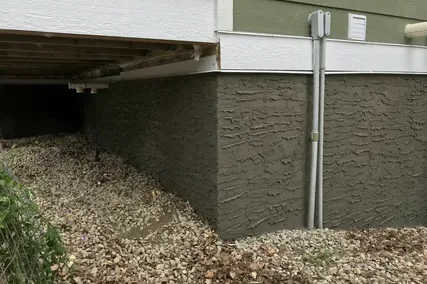
Parging carried back under a deck
This foundation has a textured parge coat carried all the way back under the deck, a low section that is easy to skip because it is hard to reach. Orleans homes from the 1980s and 1990s are reaching the age where a full recoat like this comes due.
Parging in Orleans, a suburb whose parging is aging together
Ottawa Parging Experts works across Orleans, an eastern suburb that grew from a small community into one of Ottawa's largest residential areas through concentrated development in the 1980s, 90s, and 2000s. That rapid, concentrated growth means a large share of Orleans homes fall into a similar parging-age window – if your street was built out in a particular wave, there's a good chance nearby homes are hitting the same recoat timeline around the same period.
The clustering runs deeper than age alone. Homes built in the same phase were built by the same crews, to the same detail, with the same wall height above grade and the same original mix. When one street starts showing crumbling along the bottom band, it is rarely coincidence: the coating on those walls has been through the same number of winters at the same thickness. Convent Glen and the older Chapel Hill streets are further along that curve than Avalon and the eastern phases, which are only now entering the second half of a typical 10 to 25 year lifespan.
Most Orleans foundations are poured concrete, which is what the 1980s onward built almost everywhere in the city. A poured wall does not have mortar joints to lose, so failure shows up as the coat separating from a dense, smooth substrate. That separation is often invisible until you tap the wall and hear the change from solid to hollow, which is why a street where several neighbours have had work done is a reasonable prompt to have your own wall checked even when nothing looks wrong from the driveway.
What we plan around on Orleans parging jobs
Neighbourhoods closer to the Ottawa River and Petrie Island can see different drainage and grading conditions than Orleans streets further inland, which we factor into any waterproofing-adjacent assessment.
The east end has real elevation change built into it. Streets on the higher ground south of the older core sit well above the river terrace, and homes on that slope often have a pronounced grade fall across the lot, which means one elevation of the foundation is barely exposed while the rear or side wall shows a full storey. Water arriving from uphill collects against the low side, and that is where the coating gets tested hardest. Lower riverside lots have the opposite problem: less slope to shed water at all, and a water table that comes up in spring.
Underneath much of it is Leda clay, the sensitive marine clay left across the Ottawa area by the Champlain Sea. Clay holds water against the wall long after a rain has passed and moves seasonally as it wets and dries. That combination is why the 12 to 18 inches above grade is the most common failure point on Orleans walls, and why walls that show recurring hairline cracking are usually better served by flexible acrylic parging than by another rigid cement coat that will crack in the same places. This climate brings dozens of freeze-thaw cycles a year, along with January cold snaps below -20C.
Access is generally easy. Orleans subdivision lots have driveways, consistent setbacks and enough side yard to move material, though older Chapel Hill streets have mature landscaping tight against the wall in places, and fenced rear yards on the slope sometimes mean a longer carry to the working face.
Book a parging inspection in Orleans
Given how many Orleans homes share a similar construction era, we often get several inquiries from the same street or subdivision phase within a short window. If your neighbours have had parging work done recently, mentioning that when you request a quote helps us understand what we might be looking at on your property too.
Tell us your Orleans address and what you're seeing, and we'll confirm coverage and next steps.
Photos work well for a first pass here. A shot along the base of each wall, one close-up of any crumbling or cracking, and one showing where the downspouts discharge is usually enough to tell you whether you are looking at a patch in the $300 to $600 range, a moderate repair at $600 to $1,500, or a full recoat. The written quote follows within 24 hours either way, and if the honest answer is that your wall can wait another season, that is what you will get.
For a closer look at how quotes are built, see the parging cost page. Neighbouring Cumberland and Navan are part of the same service area.
Local questions
Do you serve all of Orleans?
Yes, including Chapel Hill, Fallingbrook, Convent Glen, and Avalon – tell us your address and we'll confirm.
Most Orleans homes are a similar age – does that mean my parging needs work?
Not automatically, but a large share of Orleans housing dates to a similar development window, so if your neighbours are having parging done, it's worth a free inspection even if your wall looks fine.
Get my 24-hour quote
Free on-site or photo estimate, written quote within 24 hours.
To provide the best experiences, we use technologies like cookies to store and/or access device information. Consenting to these technologies will allow us to process data such as browsing behaviour or unique IDs on this site. Not consenting or withdrawing consent, may adversely affect certain features and functions.
Functional
Always active
The technical storage or access is strictly necessary for the legitimate purpose of enabling the use of a specific service explicitly requested by the subscriber or user, or for the sole purpose of carrying out the transmission of a communication over an electronic communications network.
Preferences
The technical storage or access is necessary for the legitimate purpose of storing preferences that are not requested by the subscriber or user.
Statistics
The technical storage or access that is used exclusively for statistical purposes.The technical storage or access that is used exclusively for anonymous statistical purposes. Without a subpoena, voluntary compliance on the part of your Internet Service Provider, or additional records from a third party, information stored or retrieved for this purpose alone cannot usually be used to identify you.
Marketing
The technical storage or access is required to create user profiles to send advertising, or to track the user on a website or across several websites for similar marketing purposes.