Free On-Site or Photo EstimateWritten Quote in 24 HoursPatch Repairs $300-$600
Parging Sarsfield
Foundation parging repair and recoating for Sarsfield farmhouses, rural bungalows and outbuildings in Ottawa’s east end.
Get my 24-hour quote
Tell us your Sarsfield address and what kind of wall is under the coating.
Service availability is confirmed for each request.
Sarsfield rural conditions we account for
Irish then francophone farm hamlet
Sarsfield was named for the Irish soldier Patrick Sarsfield and settled by Irish families, then became predominantly French-speaking as farm families moved in. Its oldest walls date from that farming era.
Deep lots and long driveways
Most Sarsfield properties are rural acreage with gravel or long paved drives, open yards and outbuildings, so mixing and staging near the wall is usually easy rather than tight.
Wells, septic beds and grading
Rural yards manage their own drainage. Where grade slopes toward the house or snow gets pushed against the wall each winter, the splash zone takes far more punishment than it does on a serviced suburban lot.
Recent project
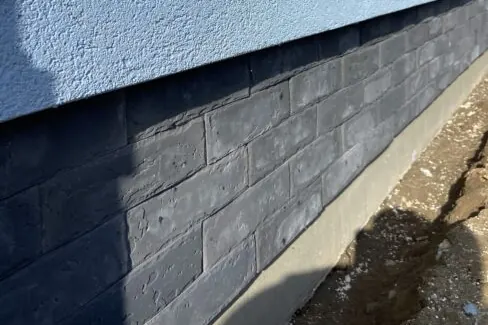
Stone-pattern parging below a stucco wall
Below a textured stucco wall, the base of this house is finished in a dark stone pattern, with the trench still open beside it. On Sarsfield’s rural lots the whole foundation is usually on show, so the finish matters to how the house looks.
Parging in Sarsfield, a rural crossroads in Ottawa's east end
Ottawa Parging Experts covers Sarsfield, a small rural community in the former Cumberland Township, now part of the City of Ottawa, sitting inland from the Ottawa River on the concession roads roughly 35 km east of downtown. Unlike the Prescott-Russell villages further east, Sarsfield never became a commuter subdivision. It is still a farm crossroads with a church, a hall and a scatter of houses, surrounded by working fields.
Its name comes from Patrick Sarsfield, the Irish soldier, and Irish settlers established the place in the nineteenth century. Over the generations French-speaking farm families became the majority, and the community has been largely francophone for a long time now. That layered settlement history is written into the buildings. The oldest foundations around Sarsfield are farm-era walls, fieldstone or early block, often with additions built decades later in a different material entirely. Between them sit rural bungalows and country builds added over the second half of the twentieth century and since.
What we plan around on Sarsfield parging jobs
Rural properties fail differently than suburban ones, and the difference is mostly about what happens at the bottom of the wall. On a serviced subdivision lot the grading was engineered once and rarely changes. On a Sarsfield acreage, the grade is whatever years of farming, landscaping and driveway work have left behind, and it frequently slopes the wrong way. Add snow ploughed off a long drive and banked against the house all winter, and the 12 to 18 inches above grade takes a beating no suburban wall sees.
That band is where nearly every parging failure starts anyway. The Ottawa area runs through dozens of freeze-thaw cycles a year and cold snaps below -20C, mostly in January. Water held in a coating expands each time the temperature crosses zero. Held long enough, the coat debonds and lifts away in plates.
The other Sarsfield variable is what is behind the parging. Mixed substrate is normal here: fieldstone under the original house, block under a 1960s addition, poured concrete under something newer. Those materials take a coating differently and they move differently, so we look at the transitions closely and prep each section on its own terms instead of skimming everything the same way.
Much of the surrounding ground is the region's sensitive marine clay, left behind by the Champlain Sea, which swells and shrinks seasonally and can telegraph fine cracking through a rigid coat. On walls that keep moving or stay damp, particularly shaded north faces and anything near a wet yard, we would recommend flexible acrylic parging. On dry, stable walls, polymer-modified, fibre-reinforced cement parging holds up better against impact, mowers and snow clearing.
Access, at least, is the easy part. Sarsfield lots are deep with room to work, and outbuildings, garages and barn foundations can be looked at in the same visit as the house.
Book a parging inspection in Sarsfield
Tell us the address, the approximate age of the building and what the wall is doing. We can come out for a free on-site estimate or work from photos if that suits you better, and the written quote follows within 24 hours with a clear statement of whether this is a patch, a section, or a full perimeter job.
Spot repairs generally run $300 to $600. Moderate repairs run $600 to $1,500. Extensive repair or a full recoat runs $1,500 to $6,000. A full perimeter recoat or new application is quoted at $15 to $30 per linear foot, which comes to roughly $2,250 to $4,500 on a typical 150 linear foot home. Larger farm buildings are measured the same way, by the running foot.
Because parging needs above-freezing temperatures to cure, Sarsfield work is scheduled inside the frost-free season, about 160 days in an Ottawa year, roughly late April to early October. Fine surface cracks can wait for next spring without much risk. Loose, hollow or falling material should not sit through another winter of snowbanks against the wall. Kept in reasonable condition, a parge coat here should last somewhere in the 10 to 25 year range.
Typical Ottawa price ranges, and the reasons a quote lands high or low, are on our parging cost page. Neighbouring Navan is part of the same service area.
Sarsfield parging questions
Our Sarsfield farmhouse has fieldstone under the original part and block under the addition. Can one coat cover both?
It can be finished to look continuous, but the two substrates are prepped and keyed differently and they move differently, so we treat the joint between them carefully rather than pretending it is one wall.
Is a long gravel driveway a problem for reaching a Sarsfield foundation?
Rarely. Rural access here is usually easier than a tight village lot. We confirm turning space and where we can stage materials when we look at the property.
Snow gets ploughed up against the house all winter on our Sarsfield lot. Is that what is wrecking the parging?
It is a common cause. A snowbank held against the wall keeps the base wet through every thaw, and repeated freezing behind the coating is what breaks the bond and lifts it off in plates.
Get my 24-hour quote
Free on-site or photo estimate, written quote within 24 hours.
To provide the best experiences, we use technologies like cookies to store and/or access device information. Consenting to these technologies will allow us to process data such as browsing behaviour or unique IDs on this site. Not consenting or withdrawing consent, may adversely affect certain features and functions.
Functional
Always active
The technical storage or access is strictly necessary for the legitimate purpose of enabling the use of a specific service explicitly requested by the subscriber or user, or for the sole purpose of carrying out the transmission of a communication over an electronic communications network.
Preferences
The technical storage or access is necessary for the legitimate purpose of storing preferences that are not requested by the subscriber or user.
Statistics
The technical storage or access that is used exclusively for statistical purposes.The technical storage or access that is used exclusively for anonymous statistical purposes. Without a subpoena, voluntary compliance on the part of your Internet Service Provider, or additional records from a third party, information stored or retrieved for this purpose alone cannot usually be used to identify you.
Marketing
The technical storage or access is required to create user profiles to send advertising, or to track the user on a website or across several websites for similar marketing purposes.