Free On-Site or Photo EstimateWritten Quote in 24 HoursPatch Repairs $300-$600
Parging Arnprior
Foundation parging repair and recoating for Arnprior, from the old lumber-town grid near the Madawaska to newer builds on the edge of town.
Get my 24-hour quote
Tell us your Arnprior address and what you are seeing at the base of the wall.
Service availability is confirmed for each request.
What shapes parging work in Arnprior
Lumber-era street grid
Arnprior was built up around sawmilling where the Madawaska meets the Ottawa River, and the tight older grid still holds late 19th century houses on fieldstone and early block cellars.
Sand near the rivers
Much of the ground close to the Ottawa River is sandy terrace rather than heavy clay. It drains quickly, but loose backfill settles and pulls the parge coat away from the wall at the corners.
Open exposure to the valley
Homes on the river side of Arnprior take driving rain and wind-packed snow straight off open water, which loads the splash zone harder than a sheltered inland lot.
Recent project
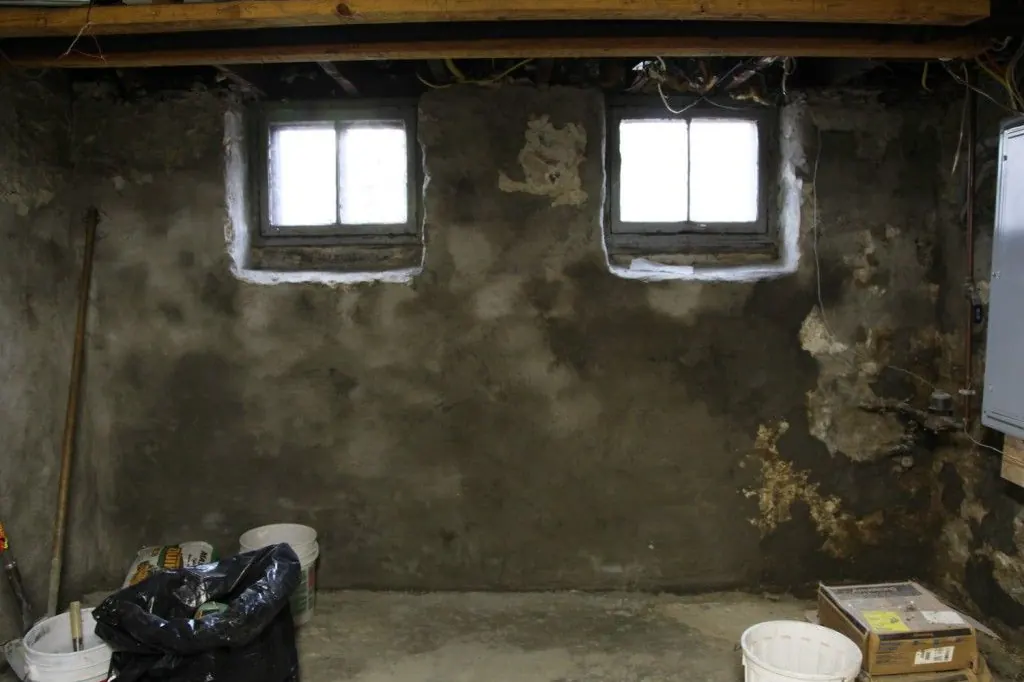
Basement parging on an old stone wall
This basement’s old stone wall carries a parge coat on the inside face, with bright returns around both windows and a few bare patches of stone still showing on the right. Arnprior’s older town-core houses get the same care inside the basement as on the outside walls.
Parging in Arnprior, a lumber town where the Madawaska meets the Ottawa
Ottawa Parging Experts travels out to Arnprior, the Ottawa Valley town roughly 55 kilometres west of the city where the Madawaska River empties into the Ottawa. Settlement here began in the 1820s under the McNab land scheme, which brought Scottish families into the township, and the name itself was carried over from Arnprior in Scotland. What really built the place was timber. Through the second half of the 19th century large-scale sawmilling at the mouth of the Madawaska shaped the street grid, the size of the lots and the kind of housing that got put up for the people who worked there.
That leaves a compact older core of late 19th and early 20th century homes, mostly on fieldstone or early block cellars, surrounded by mid-century housing from the town's later industrial years and then more recent subdivision growth on the outskirts. A parge coat on the older stock has often been renewed two or three times; on the newer stock it may still be the original builder's application.
What we plan around on Arnprior parging jobs
Ground conditions here are not uniform, and that changes the diagnosis. Land along the Ottawa River side of town tends toward sandy terrace deposits that drain quickly, so those walls see less sustained hydrostatic pressure than a foundation sitting in heavy clay. The trade-off is settlement. Loose sandy backfill keeps consolidating for years after a build, and as it drops it drags on the coating and opens a hairline separation behind the parging, usually first at the outside corners and at the step down to a garage slab.
Exposure is the second factor. Properties facing open water take wind-driven rain and packed snow directly against the wall, and the band 12 to 18 inches above grade is where that load concentrates. That zone is the most common failure point on any foundation in this region, and dozens of freeze-thaw cycles a year work on it. Cold snaps in this part of the valley drop below -20C, mostly in January, and every hard freeze expands whatever water sat in the coating that afternoon.
On the older fieldstone walls in the town core we slow down. Hard cement over soft stone and lime mortar seals a wall that needs to breathe, and the moisture then exits through the stone faces and joints, which is how you end up with spalled stone hidden behind an intact-looking coat. Where a coating is right for the wall we favour flexible acrylic parging on anything that stays damp or moves through the seasons, and polymer-modified, fibre-reinforced cement parging where the substrate can take it.
Book a parging inspection in Arnprior
Send the address, the age of the house if you know it, and a short note on what is happening at the wall. We will arrange a free on-site or photo estimate and return a written quote within 24 hours. If you are photographing it, include the full elevation, a close view of the worst spot, and one frame showing the grade line and any downspout nearby.
We will also tell you when nothing needs doing yet. A contained area of loose coating on a sound wall is patch work, usually $300 to $600, and it can generally wait for warm weather. Damage across a full elevation tends to land between $600 and $1,500. Extensive repair or a full recoat runs $1,500 to $6,000, or $15 to $30 per linear foot, roughly $2,250 to $4,500 on a typical 150 linear foot house. Parging lasts about 10 to 25 years, so age alone is often the honest answer for an Arnprior home that has not been recoated in a generation.
Does Arnprior's sandy ground mean parging lasts longer here?
Sandy soil drains faster and puts less standing water against the wall, which helps. What it does not solve is settlement in loose backfill, which opens a gap behind the coating near corners and at the garage return. We check for that before quoting.
Our house dates from the sawmill years and the cellar wall is fieldstone. Can it be coated?
Possibly, but a rigid cement coat over old stone and lime mortar can do more harm than good by trapping moisture in the wall. On those foundations we look at whether a breathable detail or a flexible acrylic parging suits the wall better than a hard cement mix.
How early should Arnprior work be booked to land inside the curing season?
Parging needs above-freezing temperatures to cure, and the frost-free stretch here runs roughly late April to early October. Asking for a quote in late winter usually gives the most choice of dates.
Get my 24-hour quote
Free on-site or photo estimate, written quote within 24 hours.
To provide the best experiences, we use technologies like cookies to store and/or access device information. Consenting to these technologies will allow us to process data such as browsing behaviour or unique IDs on this site. Not consenting or withdrawing consent, may adversely affect certain features and functions.
Functional
Always active
The technical storage or access is strictly necessary for the legitimate purpose of enabling the use of a specific service explicitly requested by the subscriber or user, or for the sole purpose of carrying out the transmission of a communication over an electronic communications network.
Preferences
The technical storage or access is necessary for the legitimate purpose of storing preferences that are not requested by the subscriber or user.
Statistics
The technical storage or access that is used exclusively for statistical purposes.The technical storage or access that is used exclusively for anonymous statistical purposes. Without a subpoena, voluntary compliance on the part of your Internet Service Provider, or additional records from a third party, information stored or retrieved for this purpose alone cannot usually be used to identify you.
Marketing
The technical storage or access is required to create user profiles to send advertising, or to track the user on a website or across several websites for similar marketing purposes.