Speckled textured finish on a foundation
This foundation has a brown, speckled textured finish below a white wall, with the new walkway base laid alongside. Rural homes on Dunrobin’s larger lots get the same finish options as homes in the city.
Ground conditions swing hard across Dunrobin, from shallow Precambrian bedrock along the ridge to sand and clay on the lots running down toward the Ottawa River. Backfill and drainage behave differently on each.
The 2018 tornado led to rebuilding across parts of the community, so newly poured walls now sit beside untouched 1970s foundations. Parging age here cannot be guessed from the road.
Long gravel lanes, propane tanks, decks, and mature tree cover all affect staging, and with wells rather than city water we plan mixing water for the job in advance.
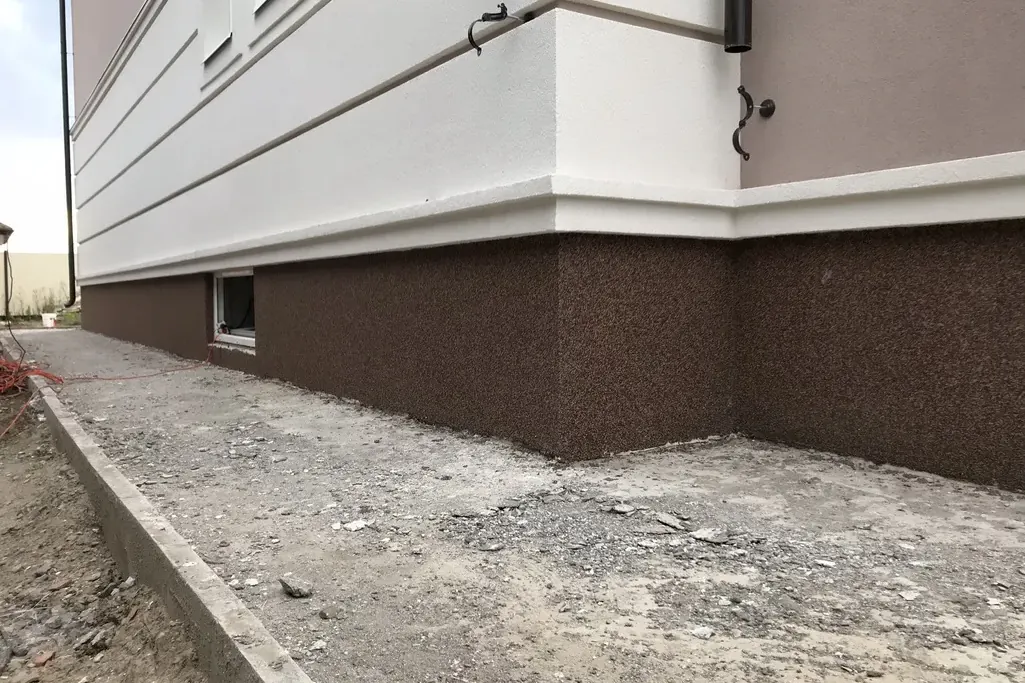
This foundation has a brown, speckled textured finish below a white wall, with the new walkway base laid alongside. Rural homes on Dunrobin’s larger lots get the same finish options as homes in the city.
Ottawa Parging Experts works out to Dunrobin, the rural west Ottawa community in the former West Carleton township named by Scottish settlers after Dunrobin in Sutherland. There is no dense village grid to speak of here. Dunrobin is a crossroads, a scattering of country severances and working farm properties, and a set of lanes running down to the Ottawa River, roughly 35 km northwest of downtown Ottawa by way of Dunrobin Road from Carp or March Road from Kanata.
The housing reflects that. Century farmhouses on stone and early concrete sit within a few concession roads of 1970s and 1980s country bungalows, 1990s and 2000s custom builds on multi-acre lots, and waterfront properties that started life as modest river places and were expanded over decades. A parging quote in Dunrobin cannot be pulled off a template, because the foundation in front of us could be from any of those eras.
There is a further layer that anyone working here has to account for. The September 2018 tornado cut through Dunrobin and damaged or destroyed a significant number of homes, which means parts of the community now carry foundations poured within the last several years standing directly beside neighbours whose walls have not been touched in fifty. We assess each wall on what it actually shows rather than assuming an age from the address.
Ground conditions vary more here than in a suburb. The Carp Ridge brings shallow Precambrian bedrock close to surface across parts of the area, while lots closer to the Ottawa River sit on sand and clay. That affects how backfill settles, how water moves away from a wall, and how much seasonal movement a rigid parge coat has to absorb. On walls that visibly move or that stay damp, we look seriously at flexible acrylic parging rather than defaulting to a cement mix.
Access is the other rural factor. Long gravel driveways, propane tanks set close to the house, wraparound decks, mature cedar and maple cover that keeps a north wall shaded and slow to dry, and landscaping built tight against the foundation all shape how a job is staged. None of that is a problem, but it does need to be known before a crew is standing in the yard.
Dunrobin runs on wells and septic rather than municipal services, so we plan the water for mixing in advance rather than assuming a hose bib. We would rather arrive with what the job needs than put an unexpected draw on a household well in August.
The physics do not change out here. This market goes through dozens of freeze-thaw cycles a year, and the bottom 12 to 18 inches above grade takes almost all of it. Parging needs above-freezing temperatures to cure, so Dunrobin work runs spring through fall, roughly late April to early October.
Give us your Dunrobin address, a note on how long the lane is, and clear photos of the wall including a low shot at the base where the coating meets the ground. That is usually enough for a written quote within 24 hours, and if a site visit makes more sense we will book one.
Because the drive out is real, we will be honest with you about scope before anyone gets in a truck. If what you have is a patch repair on one corner, we will tell you that rather than talk you into a perimeter recoat you do not need yet.
You can compare those ranges with the full breakdown on our parging cost page. We also work in nearby Constance Bay.
We plan water for every rural job before we arrive and confirm it with you at booking. On acreage properties we would rather bring what we need than put an unexpected draw on a household well, particularly late in a dry summer.
Fresh backfill around a new foundation keeps settling for several years, and builder parging is often a thin single pass. Hairline shrinkage cracks in the first few seasons are common and usually a repair rather than a full recoat.
It can. A wall bearing on shallow bedrock moves less than one on deep fill, so cracking patterns differ, but the exposed part of the wall still takes the same freeze-thaw punishment. We judge the coat by its bond and its condition at the base, not by what it sits on.