Free On-Site or Photo EstimateWritten Quote in 24 HoursPatch Repairs $300-$600
Parging Gloucester
Foundation parging repair and recoating across Gloucester’s residential and mixed-use neighbourhoods.
Get my 24-hour quote
Tell us your Gloucester address.
Service availability is confirmed for each request.
Local factors we plan around
Former independent city
Gloucester was its own city until Ottawa's 2001 amalgamation, with housing stock spanning several decades.
Mixed residential and industrial
Gloucester includes both residential streets and industrial-adjacent zones, which we factor into commercial scoping.
Broad geographic spread
Gloucester covers a wide area of southeastern Ottawa with varied lot types.
Recent project
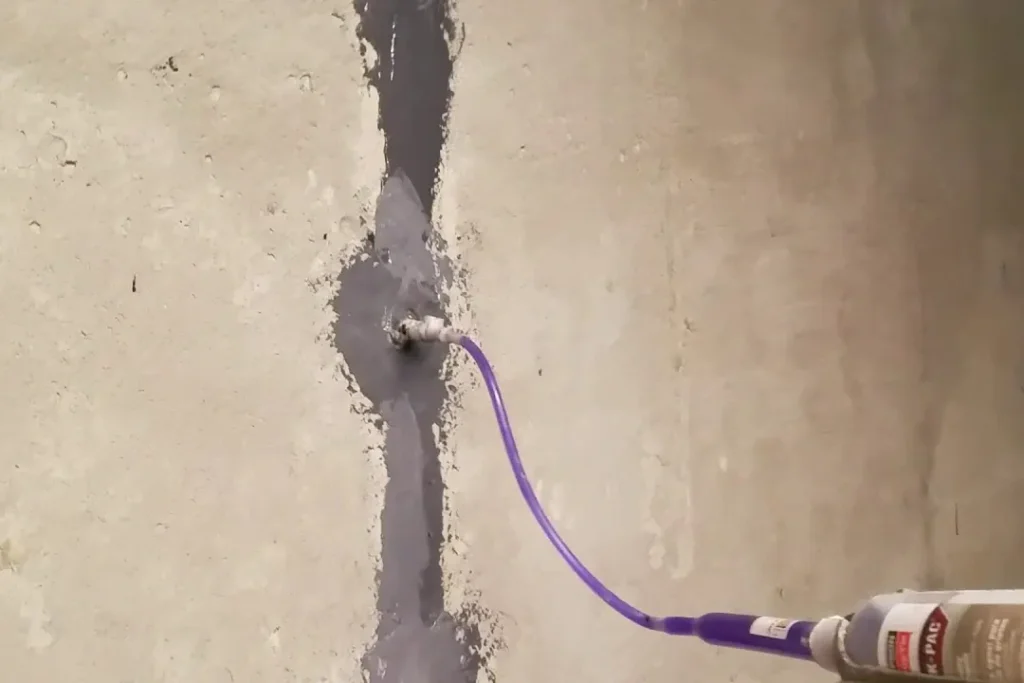
Crack injection on a poured foundation wall
This vertical crack was sealed on the surface and fitted with an injection port, then filled from a cartridge through the port. Gloucester subdivisions from the 1970s onward are mostly poured concrete, where cracks like this one show up in the wall itself.
Parging in Gloucester, a former city with a wide residential mix
Ottawa Parging Experts works across Gloucester, a large southeastern area that operated as its own independent city until Ottawa's 2001 amalgamation. That history left Gloucester with a broad mix of housing stock spanning several decades, alongside residential streets sitting near industrial and mixed-use zones – a wider variety of property types than many single-era Ottawa suburbs.
The practical consequence is that foundation construction changes from one Gloucester pocket to the next. Streets built in the 1950s and 1960s commonly sit on concrete block, where a parge coat has to span dozens of mortar joints and cracks tend to follow those joints in a stepped line. Subdivisions from the 1970s onward are far more often poured concrete, where the coat is a continuous skin and failure shows up as debonding and drummy hollow patches rather than as neat cracks. Newer builds usually carry a below-grade damp-proofing membrane the older ones never had, which changes how much moisture arrives at the visible band of wall.
We assess each Gloucester property on its own condition rather than assuming a single age profile for the area, since the range of construction dates here is wider than in more uniformly developed neighbourhoods.
What we plan around on Gloucester parging jobs
Properties near Gloucester's industrial-adjacent zones sometimes fall under our commercial scheduling approach rather than standard residential timing – see our commercial parging page for that distinction.
Ground conditions vary across this area as much as the housing does. Parts of Gloucester sit on the flatter, low-relief land of Ottawa's east end, where surface water leaves slowly and lots depend on engineered swales between properties to move it along. When a swale gets filled in by later landscaping, a fence line or an added shed pad, roof and yard water ends up standing against a foundation it was never meant to reach. Elsewhere the soil profile includes Leda clay, a sensitive marine clay left by the Champlain Sea, which shrinks in dry spells and swells again when the rain returns.
Both conditions come back to the same mechanism at the wall. Parging is a sacrificial coat, and it survives on its ability to dry out between wettings. A wall that stays saturated goes into every cold night full of water, and this climate brings dozens of freeze-thaw cycles a year. Where a Gloucester wall stays damp or shows ongoing movement, flexible acrylic parging is the better material; where the wall is dry and stable, the polymer-modified, fibre-reinforced cement mix gives a harder, longer-wearing surface.
Access is generally the easy part in Gloucester. Wider suburban lots and industrial-adjacent frontages usually leave enough room to stage mixing near the wall and work a full elevation in one pass, which keeps a job to fewer visits.
Book a parging inspection in Gloucester
Given Gloucester's wide geographic spread and mix of property types, telling us your specific neighbourhood and whether the property is residential or commercial helps us scope your request accurately from the start. Tell us your address and what you're seeing, and we'll confirm coverage and schedule a free inspection or photo review.
For commercial or industrial-adjacent Gloucester properties, see our commercial parging page for how phased scheduling and property manager documentation work – the process differs somewhat from a standard residential visit.
Timing a Gloucester parging job around the season
Parging is temperature-dependent work. The material has to cure above freezing, which in practice means the Ottawa frost-free season, roughly 160 days from late April to early October. Anything outside that window waits, and we will say so rather than place a coat that will not gain strength.
That leaves two sensible slots. Spring work gets the wall protected before a full summer of rain and a full winter of frost, though early spring across Gloucester's flatter ground can mean waiting a week or two for saturated soil to drain enough to work the base of the wall. Late summer into early fall is usually the driest, most predictable stretch, but book with enough margin that the coat has warm days to cure rather than being placed against the first cold snap.
If a wall lets go in November, it almost always waits until spring. One winter of exposure on an otherwise sound foundation is a manageable risk, even with January cold snaps below -20C, so the honest advice is to keep water off the area, note what changes over the winter, and book the assessment early in the season. Estimates are free, on site or by photo, with a written quote inside 24 hours.
If only part of the wall has failed, start with our parging repair page. The parging cost page breaks those figures down by repair type. Neighbouring Blackburn Hamlet and Alta Vista are part of the same service area.
Local questions
Do you serve all of Gloucester?
Yes, across Gloucester's residential neighbourhoods – tell us your address and we'll confirm.
Do you handle Gloucester's commercial and industrial-adjacent properties?
Yes – see our commercial parging page for how we scope and schedule work on non-residential properties.
Get my 24-hour quote
Free on-site or photo estimate, written quote within 24 hours.
To provide the best experiences, we use technologies like cookies to store and/or access device information. Consenting to these technologies will allow us to process data such as browsing behaviour or unique IDs on this site. Not consenting or withdrawing consent, may adversely affect certain features and functions.
Functional
Always active
The technical storage or access is strictly necessary for the legitimate purpose of enabling the use of a specific service explicitly requested by the subscriber or user, or for the sole purpose of carrying out the transmission of a communication over an electronic communications network.
Preferences
The technical storage or access is necessary for the legitimate purpose of storing preferences that are not requested by the subscriber or user.
Statistics
The technical storage or access that is used exclusively for statistical purposes.The technical storage or access that is used exclusively for anonymous statistical purposes. Without a subpoena, voluntary compliance on the part of your Internet Service Provider, or additional records from a third party, information stored or retrieved for this purpose alone cannot usually be used to identify you.
Marketing
The technical storage or access is required to create user profiles to send advertising, or to track the user on a website or across several websites for similar marketing purposes.