Free On-Site or Photo EstimateWritten Quote in 24 HoursPatch Repairs $300-$600
Parging Limoges
Foundation parging repair, recoating and new application for Limoges homes on the sand plain beside Larose Forest.
Get my 24-hour quote
Tell us your Limoges address and roughly when the house was built.
Service availability is confirmed for each request.
Limoges ground and housing we quote on
The Larose Forest sand plain
Limoges sits on sandy ground beside Larose Forest, replanted from the 1920s onward after logging left the sand blowing. Sand drains faster than the region's clay, which changes how the base of a wall behaves.
Fast recent build-out
Limoges has grown quickly as an Ottawa commuter address, so a large share of its foundations are recent poured concrete carrying an original, first-generation parge coat.
Highway 417 at Limoges Road
The village is a few minutes off the 417 interchange, roughly 45 km from downtown Ottawa, so a photo estimate and an on-site look are equally practical here.
Recent project
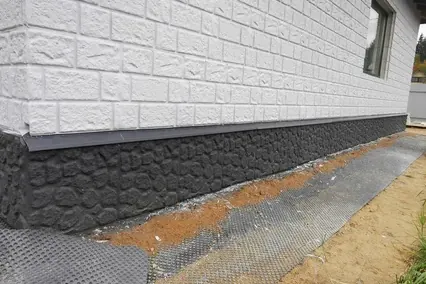
Stone-pattern parging below siding
A dark, stone-pattern parge coat runs the length of this foundation below light siding, with a membrane laid along the ground beside it. Limoges sits on sand rather than the heavy clay found across most of Prescott-Russell, which changes how water drains at the base of the wall.
Parging in Limoges, a sand-plain village beside Larose Forest
Ottawa Parging Experts works in Limoges, a village in the municipality of The Nation in Prescott-Russell, sitting a few minutes off Highway 417 at the Limoges Road interchange, roughly 45 km east of downtown Ottawa. Limoges came into being late in the 1800s around the railway and the timber trade, was settled by French-speaking families, and has been a francophone community since. For most of the twentieth century it was a small crossroads hamlet serving farms.
What sets Limoges apart from the villages around it is the ground under it. This corner of the county is sand, not the heavy clay that covers most of Prescott-Russell. That sand was stripped bare by logging and farming and began to blow, and starting in the late 1920s the county reforested it, which is how Larose Forest came to exist next door. That history is not trivia for us. Sand behaves differently against a foundation than sensitive marine clay does, and it changes what we expect to find at the base of a wall.
The other Limoges characteristic is age. The village has grown fast in recent decades as commuters chose the 417 corridor, so a large proportion of its housing is modern, and a large proportion of its parging is original first-generation work rather than a fourth recoat over something old.
What we plan around on Limoges parging jobs
Sandy soil drains quickly and swells and shrinks far less than clay does. In practice that means Limoges walls are less prone to the fine seasonal cracking that clay-borne movement drives elsewhere in the region. It does not make them immune. Freeze-thaw damage is a function of water sitting in a coating while the temperature crosses zero, and the Ottawa area sees dozens of those cycles a year plus cold snaps below -20C. Whatever the soil, the 12 to 18 inches above grade takes the roof runoff, the shovelled snow and every one of those cycles.
On newer Limoges builds we look hard at two things. First, whether backfill has settled and left the grade dropping away from the wall, exposing a band of parging that was originally meant to be buried and was finished accordingly. Second, whether the original coat was applied thin. Production parging on fast subdivision builds is often minimal, and thin material over poured concrete debonds early at the base.
On the older village properties and the rural lots out toward the forest, the picture is different again. Those walls may be block or older concrete, sometimes with more than one previous coating, and prep work drives the price more than surface area does.
Where a wall is dry and stable, which sandy ground makes more likely here than in the clay villages, polymer-modified, fibre-reinforced cement parging is the right choice for durability. Where a wall stays damp, near a treeline or on a shaded north face that never dries, flexible acrylic parging is the safer material.
Book a parging inspection in Limoges
Because Limoges is right off the 417, both options are easy. Ask for a free on-site estimate, or send clear photos of the worst area plus a full wall shot and we will assess from those. The written quote arrives within 24 hours and tells you plainly whether you need a patch, a section, or a full perimeter recoat.
Patch repairs generally run $300 to $600. Moderate repairs run $600 to $1,500. Extensive repair or a full recoat runs $1,500 to $6,000, and a full perimeter recoat or new application is quoted at $15 to $30 per linear foot, roughly $2,250 to $4,500 on a typical 150 linear foot home.
Parging cures only above freezing, so Limoges jobs run through the frost-free season, about 160 days from late April to early October in an Ottawa year. Cosmetic hairlines can wait. A section that sounds hollow, or one dropping crumbs into the flower bed, is worth quoting this year rather than next. Done properly, a parge coat in this climate should give you somewhere between 10 and 25 years.
You can compare those ranges with the full breakdown on our parging cost page. We also work in nearby Embrun and Casselman.
Limoges parging questions
Limoges is sandy rather than clay. Does parging last longer here because of that?
Sandy ground drains better and moves less than sensitive marine clay does, so you tend to see less seasonal cracking from soil movement. Freeze-thaw damage at the splash zone still happens, because that is driven by water and temperature, not by soil type.
Our Limoges house is only about ten years old and the parging is already flaking near the ground. Why so soon?
Almost always because the bottom band never gets a break. Snow piled off the drive, roof runoff and dozens of freeze-thaw cycles a year work on the same 12 to 18 inches, and thin or poorly cured original parging gives up there first.
The grading on our new Limoges lot was only finished this year. Parge now or wait?
If the soil is still settling against the wall it is worth saying so on the quote, because backfill that drops later leaves a gap. We will tell you honestly whether to do it now or hold a season.
Get my 24-hour quote
Free on-site or photo estimate, written quote within 24 hours.
To provide the best experiences, we use technologies like cookies to store and/or access device information. Consenting to these technologies will allow us to process data such as browsing behaviour or unique IDs on this site. Not consenting or withdrawing consent, may adversely affect certain features and functions.
Functional
Always active
The technical storage or access is strictly necessary for the legitimate purpose of enabling the use of a specific service explicitly requested by the subscriber or user, or for the sole purpose of carrying out the transmission of a communication over an electronic communications network.
Preferences
The technical storage or access is necessary for the legitimate purpose of storing preferences that are not requested by the subscriber or user.
Statistics
The technical storage or access that is used exclusively for statistical purposes.The technical storage or access that is used exclusively for anonymous statistical purposes. Without a subpoena, voluntary compliance on the part of your Internet Service Provider, or additional records from a third party, information stored or retrieved for this purpose alone cannot usually be used to identify you.
Marketing
The technical storage or access is required to create user profiles to send advertising, or to track the user on a website or across several websites for similar marketing purposes.