Free On-Site or Photo EstimateWritten Quote in 24 HoursPatch Repairs $300-$600
Parging Russell
Foundation parging repair and recoating in Russell, for century walls along the Castor River and for newer builds on the edge of the village.
Get my 24-hour quote
Tell us your Russell address and roughly how old the house is.
Service availability is confirmed for each request.
Russell wall types we quote most
Castor River village core
Russell grew around mills on the Castor River from the early 1800s. Houses on the old streets nearest the water sit lowest and hold moisture at grade the longest each spring.
Rubble stone behind old coats
Under a century house in Russell there is often uncoursed fieldstone rather than block. Parging over rubble needs the loose material and old layers off first, or the new coat comes away in sheets.
Newer edges of the village
Russell's subdivision growth as an Ottawa commuter address means many walls carry an original coat now entering the back half of a 10 to 25 year lifespan.
Recent project
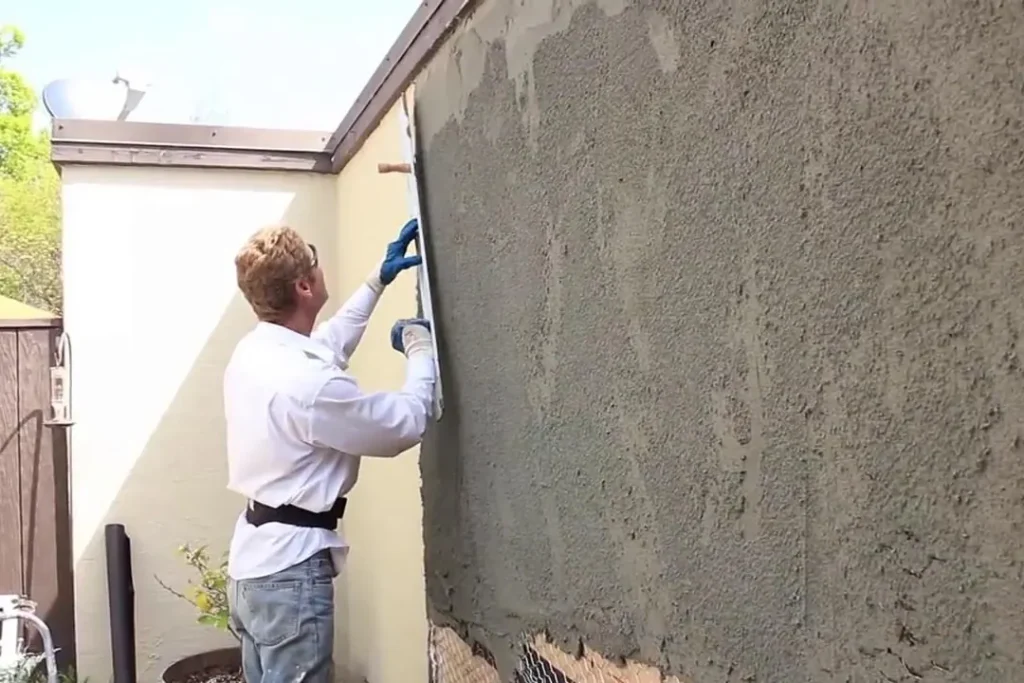
Cement coat being troweled onto a wall
A worker trowels a fresh cement coat across a tall wall, with wire mesh still showing at the bottom where the coat has not reached yet. Older Russell village homes get the same coat where the old surface has worn through.
Parging in Russell, an old Castor River mill village
Ottawa Parging Experts covers Russell, the namesake village of Russell Township, sitting on the Castor River roughly 35 km southeast of downtown Ottawa by way of County Road 26 or off Highway 417 through Vars. Russell is genuinely old by eastern Ontario standards. Settlement began in the first half of the 1800s, the river powered mills, and the village that grew around them was more mixed in origin than its neighbours to the east, English-speaking families settled alongside the French Canadian farm families who dominated the surrounding township. Both communities are still there, and the township as a whole is bilingual to this day.
For parging purposes the interesting part is the age spread. The old streets near the river and the former mill sites hold houses well over a century old, and the walls under them are frequently uncoursed fieldstone or early block rather than poured concrete. Out at the edges of the village, decades of commuter growth have added subdivision housing whose first parge coat is now working through the second half of a normal 10 to 25 year life. Those are two entirely different quotes, and we do not guess which one you have from the postal code.
What we plan around on Russell parging jobs
The first thing we check on an older Russell wall is what is actually behind the coating. Rubble stone foundations were laid up with soft lime mortar and the parging applied over them has usually been renewed several times. Each of those layers can be failing independently. Skipping prep and troweling fresh material over a hollow-sounding coat produces a wall that looks correct for a season and then comes off in sheets. Removing the failed layers back to sound substrate is most of the labour on a century house, and it is the part that determines whether the repair lasts.
The second thing is water. Russell sits low along the Castor, and the flatter, poorly drained clay of this part of the county, sensitive marine clay left by the Champlain Sea, drains slowly in spring. A wall that is still wet when the temperature swings through zero is a wall that spalls. Freeze-thaw cycles here number in the dozens each year, and January cold snaps drop below -20C. Almost every call we would expect from Russell concerns the same 12 to 18 inches above grade, because that is where the meltwater, the roof runoff and the shovelled snow all end up.
Material choice comes out of that. Dry, stable walls get polymer-modified, fibre-reinforced cement parging. Damp walls, low riverside lots and any wall showing continuing movement get flexible acrylic parging, which stays bonded through both.
Access varies more in Russell than in a pure subdivision. Village lots on the old grid can be tight, with sheds, fences or mature cedar close to the foundation, so we look at the whole perimeter before pricing it.
Book a parging inspection in Russell
Ask for a free on-site visit or send photographs of the worst section along with a wide shot of the wall. Either route gets you a written quote within 24 hours that states whether this is a patch, a section, or a full perimeter. Patch work generally falls between $300 and $600, moderate repairs between $600 and $1,500, and extensive repair or full recoat between $1,500 and $6,000. Full perimeter recoat or new application is quoted at $15 to $30 per linear foot, about $2,250 to $4,500 on a typical 150 linear foot home.
Parging cures only above freezing, so Russell work runs through the frost-free season, roughly late April to early October in an Ottawa year of about 160 frost-free days. If you spot fine cracking late in the fall it can wait for spring without harm. Bulging, hollow patches and material dropping off the wall should not wait a second winter.
There is fieldstone showing behind the broken parging on our old Russell house. Can that be recoated?
Generally yes, but the prep is the job. Loose stone and mortar have to be dealt with and every failed layer of old coating removed, otherwise the new parging bonds to something that is already letting go.
Does being close to the Castor River change how long a parge coat lasts in Russell?
Low ground near the river holds spring meltwater against the wall longer, which keeps the splash zone saturated into the freeze-thaw season. On those addresses a flexible acrylic parging is usually the better call.
We are on a gravel side road between Russell and Marionville. Is that inside your radius?
Send us the address with your request and we will confirm coverage before we book anything in.
Get my 24-hour quote
Free on-site or photo estimate, written quote within 24 hours.
To provide the best experiences, we use technologies like cookies to store and/or access device information. Consenting to these technologies will allow us to process data such as browsing behaviour or unique IDs on this site. Not consenting or withdrawing consent, may adversely affect certain features and functions.
Functional
Always active
The technical storage or access is strictly necessary for the legitimate purpose of enabling the use of a specific service explicitly requested by the subscriber or user, or for the sole purpose of carrying out the transmission of a communication over an electronic communications network.
Preferences
The technical storage or access is necessary for the legitimate purpose of storing preferences that are not requested by the subscriber or user.
Statistics
The technical storage or access that is used exclusively for statistical purposes.The technical storage or access that is used exclusively for anonymous statistical purposes. Without a subpoena, voluntary compliance on the part of your Internet Service Provider, or additional records from a third party, information stored or retrieved for this purpose alone cannot usually be used to identify you.
Marketing
The technical storage or access is required to create user profiles to send advertising, or to track the user on a website or across several websites for similar marketing purposes.