Crumbling Parging: Patch, Re-Parge, or Fix the Foundation First?
If the parging on your Ottawa foundation is cracking, flaking, or falling off, it is tempting to treat the whole thing as a cosmetic repair. Here is how Ottawa Parging Experts tells a cosmetic repair from a bigger problem.
On cost: we price parging repair at about $3 to $6 per sq. ft. and a full new coat at $5 to $10 per sq. ft. A spot repair of two or three patches typically runs $300 to $600, and re-parging the full perimeter of a house usually lands between $1,500 and $6,000.
Sometimes it is.
Sometimes the damaged parging is a sign that water, poor drainage, freeze-thaw exposure, or deterioration in the foundation underneath needs attention first.
The important question is not simply, “How do I fix the parging?”
It is:
Has the parging failed, or is there a problem with the foundation behind it?
That distinction affects the repair method, the cost, and whether patching a small area will actually solve the problem.
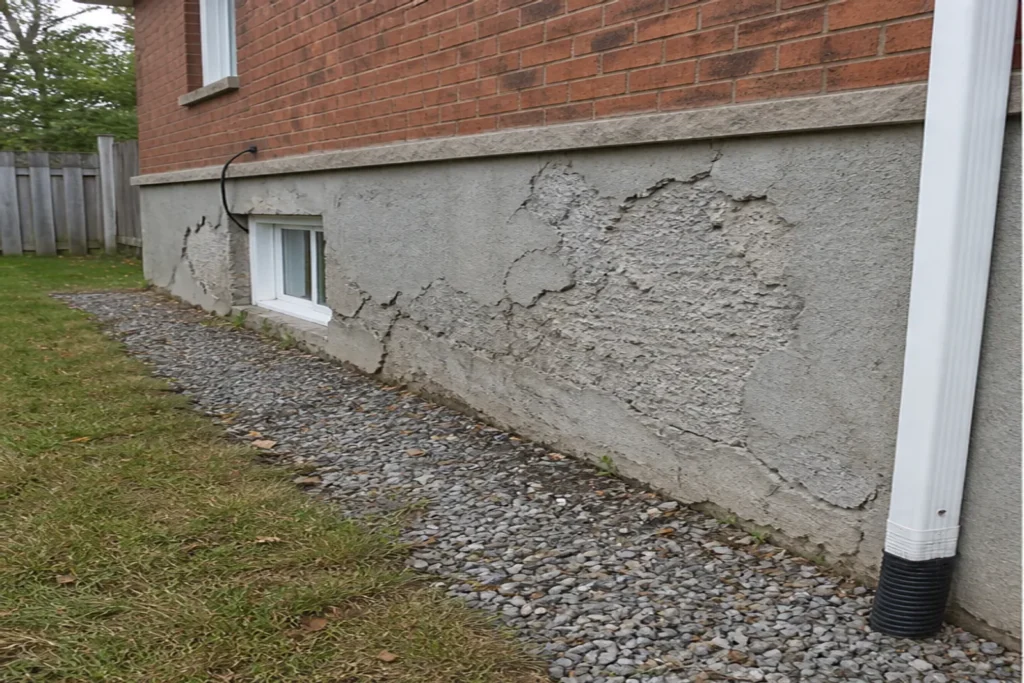
Is Crumbling Parging a Serious Problem?
Parging itself is not usually a structural part of a foundation. It is a protective and finished coating applied over materials such as concrete block or poured concrete.
That means cracked or missing parging does not automatically mean the foundation is structurally damaged.
However, damaged parging can expose the foundation to water and repeated freeze-thaw cycles. More importantly, the condition of the exposed foundation can tell you whether the problem is limited to the parging.
Pay closer attention if you see:
- Cracks continuing through the parging and into the foundation
- Bowing, displacement, or visibly deteriorated masonry
- Large areas where the foundation material is breaking down
- Persistent water entering through the foundation
- Dampness associated with poor grading or drainage
- Large hollow areas where the parging has separated from the wall
- Repeated parging failure after previous repairs
If the foundation underneath appears sound and the damage is limited to the parging, the repair is usually more straightforward.
What Does Failed Parging Look Like?
Parging can fail in several different ways.
Common signs include:
Powdery or friable surfaces
If rubbing the surface produces a lot of loose dust or grit, the outer layer may have deteriorated.
A small amount of surface dust is not necessarily a major problem. Widespread friability is more concerning.
Cracks
Hairline surface cracks can occur with normal weathering.
Larger cracks, cracks that continue through the coating, or cracks that repeatedly reopen deserve closer inspection.
Hollow areas
Lightly tapping the surface can sometimes reveal areas where the parging has separated from the foundation.
A hollow sound does not tell you everything by itself, but widespread hollow areas suggest that the coating is no longer well bonded.
Flaking and delamination
If pieces of the parging are lifting away from the wall or falling off, the bond or the material itself has failed.
Exposed concrete or block
Once the underlying foundation is exposed, the condition of that material becomes more important than the appearance of the remaining parging.
Parging Failure vs. Foundation Damage
These problems can look similar from a distance.
| What you see | More consistent with | What to check |
|---|---|---|
| Surface is powdery or weathered | Parging deterioration | Whether the foundation underneath is sound |
| Parging is cracked but foundation is intact | Parging failure | Crack size, extent, and moisture exposure |
| Large hollow sections | Bond failure | How much of the coating has separated |
| Concrete block is visibly deteriorated | Possible foundation deterioration | Masonry condition and moisture exposure |
| Crack continues into the foundation | Possible foundation movement or cracking | Width, direction, location, and changes over time |
| Water is entering through the wall | Moisture problem | Grading, drainage, waterproofing, and crack location |
| Parging repeatedly fails in the same area | Underlying cause may remain | Water, movement, preparation, or substrate condition |
There are two useful ways to think about parging failure.
Cohesive failure means the parging itself is breaking apart.
Bond failure means the parging remains relatively intact but has separated from the foundation.
The distinction matters because a wall with widespread bond failure needs different preparation from a wall where only the surface has weathered.
Why Does Parging Fail in Ottawa?
Ottawa foundations are exposed to significant seasonal temperature changes, moisture, and repeated freeze-thaw conditions.
Several factors can contribute to parging deterioration.
Freeze-thaw exposure
Water can enter small pores and defects in the material. When that water freezes, it expands. Repeated cycles can contribute to cracking, scaling, and deterioration.
This is one reason exterior masonry coatings need to be installed and maintained properly.
Water
Water is often more important than the parging material itself.
Poor grading, downspouts discharging near the foundation, clogged drainage systems, or persistent wet conditions can contribute to deterioration.
If a section of parging keeps failing in the same location, look for the moisture source instead of simply applying another layer.
Poor surface preparation
New material needs an appropriate substrate.
Dust, loose material, contamination, weak old coatings, and poorly prepared surfaces can interfere with adhesion.
This is particularly important when a contractor is applying new parging over an existing surface.
Previous repairs
Older patches may be made from a different material or may have been applied over a weak substrate.
A wall can therefore contain several layers with different levels of adhesion and durability.
Physical exposure
Foundation walls near driveways, walkways, landscaping, and areas exposed to road salt can experience additional wear.
The exact cause varies from property to property, so a visual inspection is more useful than assuming every Ottawa parging failure has the same cause.
Should You Patch the Parging or Re-Parge the Whole Wall?
The right repair depends on how much of the existing coating remains sound.
Patching makes sense when:
- Damage is limited to a small area
- Surrounding parging is firmly bonded
- The foundation underneath is sound
- There is no ongoing moisture problem
- The damaged material can be removed and the substrate properly prepared
- The repair will not simply cover loose or hollow material
A small patch is usually preferable to removing sound material unnecessarily.
Re-parging makes more sense when:
- Large areas are hollow
- Significant sections are loose or delaminating
- The existing surface is broadly deteriorated
- There are many repairs across the same wall
- The remaining coating is poorly bonded
- A large portion of the wall needs to be removed before a new finish can be applied
The decision should be based on the condition of the wall, not an arbitrary percentage of damaged surface.
There is no reliable rule that says, for example, that a certain percentage of damage automatically means the entire foundation must be re-parged.
What About Recoating?
Re-coating and re-parging are not necessarily the same thing.
A thin finish coat may improve appearance and protect a suitable substrate, but it should not be used to hide loose, hollow, contaminated, or deteriorated material.
Before applying another coating, the contractor should determine whether the existing surface is suitable to receive it.
If the old parging is poorly bonded, applying new material over it can leave the underlying problem in place.
Parging Repair Cost in Ottawa
There is no single Ottawa price because the amount of preparation can vary dramatically from one house to another.
A small repair where the substrate is accessible and sound is very different from a project that requires extensive removal, surface preparation, access equipment, and full-wall re-parging.
We price a spot repair at $300 to $600 and full-perimeter re-parging at $1,500 to $6,000. Most jobs also carry a minimum charge of roughly $300 to $500 to cover setup.
Here is how we price the work:
| Type of work | Typical Ottawa price |
|---|---|
| Spot repair (2 to 3 patches, 20 to 50 sq. ft.) | $300 to $600 |
| Parging repair priced by area | $3 to $6 per sq. ft. |
| Full new coat priced by area | $5 to $10 per sq. ft. |
| New parging priced by length (about 2 ft. high) | $15 to $30 per linear ft. |
| Strip old parging and replace | $20 to $40 per linear ft. |
| One wall (80 to 150 sq. ft.) | $500 to $1,500 |
| Full perimeter, bungalow (250 to 400 sq. ft.) | $1,500 to $3,500 |
| Full perimeter, two-storey (400 to 700 sq. ft.) | $3,000 to $6,000 |
The final price can change substantially depending on:
- Amount of loose parging that must be removed
- Condition of the foundation
- Surface preparation
- Foundation height
- Access around the house
- Landscaping or structures blocking access
- Number of corners and transitions
- Whether cracks require separate repair
- Whether moisture problems need to be addressed
- Material selected
- Whether the project requires multiple coats
- Cleanup and disposal
A contractor quoting $3 per square foot and another quoting $8 per square foot may not actually be quoting the same scope of work.
That is why comparing the total number alone can be misleading.
How to Compare Parging Quotes
Ask each contractor to explain the scope of work in writing.
At minimum, the quote should identify:
- What existing material will be removed
- How much of the wall will be repaired
- How the surface will be prepared
- What material will be installed
- How many coats are included
- How cracks or damaged substrate will be handled
- Whether waterproofing or drainage work is included
- How cleanup and disposal are handled
- Whether taxes are included
- What warranty applies to the work
A useful quote should tell you what the contractor is actually doing, not just give you a total price.
How to Estimate the Amount of Parging You Need
If a contractor is pricing the work by square footage, you can get a rough idea of the wall area yourself.
For a simple rectangular section:
Wall area = length × height
For example, a 40-foot wall with 4 feet of exposed foundation would contain approximately:
40 × 4 = 160 sq. ft.
For the entire foundation, measure each exposed section and add the areas together.
This is only a rough estimate. A contractor may measure differently depending on which surfaces actually require material and how openings, corners, steps, and other details are handled.
Do not assume that multiplying the square footage by a quoted rate gives the job total. Preparation and access can be a significant part of the job.
What Does a Proper Parging Repair Involve?
A durable repair generally starts with preparation rather than immediately applying new material.
Depending on the condition of the wall, the process may include:
1. Inspecting the foundation
The contractor should determine whether the substrate is concrete, concrete block, or another material and look for cracks, deterioration, moisture, and movement.
2. Removing unsound material
Loose, hollow, poorly bonded, or deteriorated parging should generally be removed from the repair area.
3. Preparing the substrate
The surface needs to be sufficiently clean and sound for the selected repair material.
The exact preparation method depends on the substrate and product.
4. Addressing underlying problems
If water is reaching the wall because of drainage, grading, or another issue, that problem should be considered before the cosmetic repair is completed.
5. Applying the new material
The material should be installed according to the manufacturer’s requirements, including recommended thickness, bonding requirements, curing conditions, and application method.
6. Finishing and curing
The repair needs appropriate conditions to cure.
Temperature, moisture, wind, sunlight, and the specific product can all affect curing. The manufacturer’s installation requirements should take precedence over a generic rule about what weather is “good enough.”
Cement Parging vs. Acrylic-Modified Parging
The right material depends on the substrate, exposure, existing coating, and intended finish.
Traditional cement-based parging is commonly used on masonry and concrete surfaces.
Acrylic-modified or polymer-modified products can provide different performance characteristics, including improved adhesion or flexibility depending on the formulation.
That does not mean one material is automatically better for every Ottawa foundation.
The important questions are:
- Is it compatible with the existing substrate?
- Is the surface properly prepared?
- Is it appropriate for exterior exposure?
- Does the manufacturer specify it for this application?
- Is the contractor following the product’s installation requirements?
The product name matters less than whether the complete system is appropriate for the wall.
What If You Have a Concrete Block Foundation?
Concrete block foundations can require particular attention because the condition of the mortar joints and blocks matters beneath the parging.
If the parging has fallen away and you can see damaged, cracked, or deteriorated blocks, do not treat the job as a simple cosmetic patch.
The contractor should assess the masonry before covering it again.
If the blocks are sound and the issue is limited to failed parging, the repair may remain relatively straightforward.
What If You Have a Poured Concrete Foundation?
Poured concrete can also develop surface deterioration, cracking, or areas where a coating has failed.
The same basic principle applies:
Do not use new parging to conceal a problem that should be repaired first.
A crack in the parging is different from a crack in the concrete foundation itself.
If a crack continues through the coating and into the concrete, its size, direction, location, and whether it appears to be changing should be considered.
Does Crumbling Parging Mean You Need Waterproofing?
Not necessarily.
Parging and waterproofing serve different purposes.
Parging is primarily a protective and finishing coating.
Waterproofing is intended to control water penetration through the foundation assembly.
If water is entering through the foundation, simply replacing the parging may not address the cause.
Depending on the situation, the relevant issue could involve:
- Grading
- Downspouts
- Drainage
- Foundation cracks
- Exterior waterproofing
- Interior water management
- Window wells
- Other sources of water around the foundation
A contractor should identify the source before recommending a waterproofing solution.
Be cautious if a contractor sees damaged parging and immediately recommends an expensive waterproofing project without explaining the evidence for water penetration.
The opposite is also true. If there is clear evidence of water entering the foundation, cosmetic parging work alone may not solve the problem.
When Is the Best Time to Repair Parging?
Exterior cementitious products generally require suitable temperatures and curing conditions.
The acceptable conditions vary by product.
That means the contractor should follow the manufacturer’s requirements rather than relying on a generic statement such as “parging can always be done above freezing.”
Late spring, summer, and early fall can provide suitable conditions for many exterior repairs, but the actual installation window depends on the product and weather conditions.
Cold temperatures, rain, frost, and rapid temperature changes can all affect the installation.
Can You Repair Parging Yourself?
Small repairs can be within the ability of an experienced homeowner, particularly when the damaged area is accessible and the foundation underneath is clearly sound.
The difficulty is not necessarily mixing and applying the material.
The more important part is diagnosing the failure and preparing the substrate properly.
DIY becomes less appropriate when:
- Large areas are detached
- The foundation is several feet above grade
- There are structural-looking cracks
- The concrete or blocks are deteriorating
- Water is entering the basement
- Extensive removal is required
- Access is difficult
- You are unsure whether the foundation itself is damaged
For a small cosmetic repair, the risk is mainly doing the repair poorly.
For a foundation with active water or masonry problems, the risk is failing to identify the underlying issue.
Questions to Ask a Parging Contractor
Before hiring someone, ask:
“What is actually failing?”
You want to know whether the contractor believes the issue is the parging, the bond between the parging and substrate, or the foundation itself.
“How much of the existing parging needs to come off?”
A contractor should be able to explain why removal is necessary.
“How will you prepare the surface?”
This is one of the most important parts of the job.
“What product are you using?”
Ask for the product name and installation requirements.
“How will you handle cracks?”
A crack should not automatically be buried beneath a new coating.
“Do you see any foundation damage?”
If yes, ask the contractor to explain exactly what they see.
“Is waterproofing included?”
Make sure you understand whether waterproofing is part of the quote or a separate recommendation.
“What does the warranty cover?”
Ask whether the warranty covers workmanship, material failure, or both.
“What is not included?”
This question can prevent surprises later.
Warning Signs in a Parging Quote
Be cautious with quotes that:
- Give a price without inspecting the wall
- Do not explain preparation
- Promise that one coating will permanently solve every problem
- Recommend waterproofing without identifying a moisture issue
- Ignore visible foundation cracks
- Do not identify the material being installed
- Have a very low price but exclude removal and preparation
- Pressure you to approve additional work immediately
- Offer no written scope of work
A low quote is not necessarily a good quote, and a high quote is not necessarily a bad one.
The useful comparison is the scope of work behind the number.
The Bottom Line
Crumbling parging in Ottawa does not automatically mean your foundation is failing.
Start with three questions:
- Is the remaining parging firmly bonded?
- Is the foundation underneath sound?
- What caused the failure?
If the foundation is sound and the damage is localized, a parging repair on the affected areas may be enough.
If large areas are loose or poorly bonded, re-parging may make more sense.
If the foundation itself is cracked, deteriorated, displaced, or allowing water inside, the foundation problem needs to be addressed rather than simply covered with new parging.
For cost, expect about $300 to $600 for a small spot repair and $1,500 to $6,000 to re-parge the full perimeter, with the actual price depending heavily on preparation, access, material, and the condition of the existing wall.
The most useful contractor quote is not simply the one with the lowest number.
It is the one that clearly explains what failed, what will be removed, how the surface will be prepared, what will be installed, and what is included in the price.
Frequently Asked Questions
Is crumbling parging a structural problem?
Usually, parging itself is not structural. However, damage underneath the parging can indicate a separate foundation or masonry problem. The exposed substrate should be inspected before the wall is repaired.
Can I just put new parging over the old parging?
Only when the existing surface is sufficiently sound and compatible with the proposed repair. Loose, hollow, contaminated, or deteriorated material should not simply be covered.
How much does parging cost in Ottawa?
We price a small spot repair at $300 to $600, parging repair at $3 to $6 per sq. ft., and a full new coat at $5 to $10 per sq. ft. Priced by length, new parging runs about $15 to $30 per linear ft. Re-parging a full perimeter typically costs $1,500 to $6,000, depending on removal, preparation, access, material, and project size.
How long does parging last?
There is no single service life that applies to every parging installation. Longevity depends on the substrate, preparation, material, exposure to water and freeze-thaw cycles, workmanship, and maintenance.
Should I repair cracks before re-parging?
If the cracks extend into the foundation or indicate movement, they should be evaluated before applying new parging. A cosmetic coating should not be used to hide an unresolved foundation problem.
Does new parging waterproof a foundation?
No. Parging and waterproofing are different systems. Parging can provide a protective exterior coating, but it should not be treated as a substitute for a proper waterproofing system where water penetration is occurring.
Can parging be repaired in winter?
The answer depends on the specific product and installation conditions. Exterior cementitious products generally have temperature and curing requirements. The manufacturer’s requirements should be followed.
Should I re-parge the entire foundation?
Not automatically. If most of the existing parging is firmly bonded and the damage is localized, repairing the affected areas may be sufficient. Extensive bond failure or widespread deterioration can justify more comprehensive removal and re-parging.
Published by Ottawa Parging Experts, a foundation parging company serving Ottawa and nearby communities. Questions about this article? Contact us.